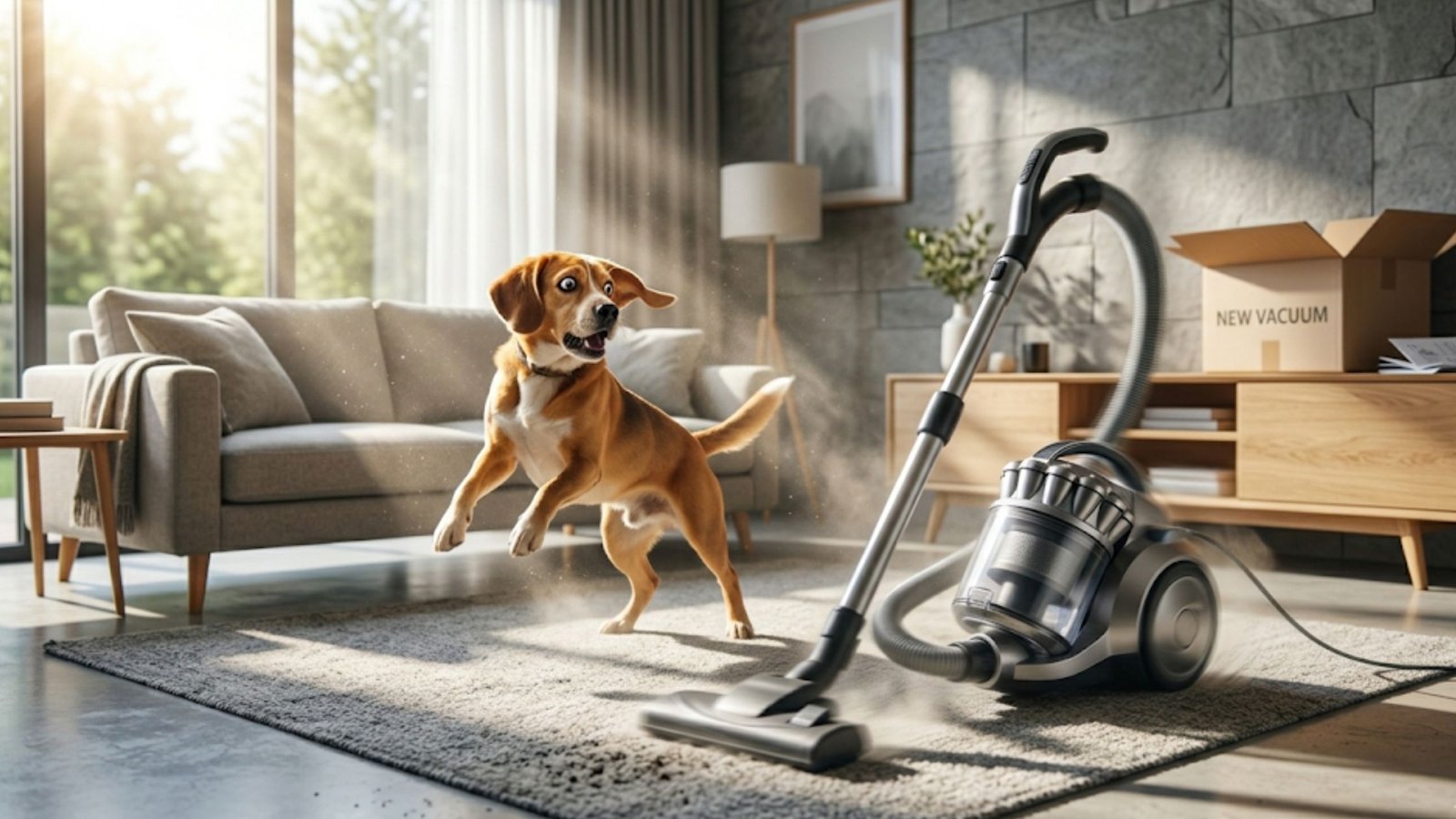
It was a typical Tuesday morning, or so I thought. I was in a great mood, had my coffee in hand, and decided to tackle the living room. The moment I rolled the vacuum out of the closet, my Golden Retriever, Charlie, who had been peacefully napping, transformed into a furry missile. His ears pinned back, his tail tucked, and he launched into a full-blown barking fit, lunging at the “monster” as if his life depended on it. I wasn’t cleaning my floors; I was mediating a war zone.
Sound familiar? If you’re reading this, you’ve probably experienced the same chaos. One minute, your home is peaceful; the next, it’s a symphony of barks, growls, and the whir of a machine you just want to use for five minutes. It’s frustrating, stressful, and honestly, it can make you feel like a bad pet parent for just trying to clean up.
But here’s the thing: your dog isn’t being “bad.” They aren’t trying to ruin your day. There’s a real, biological reason why dogs hate vacuums. And the good news? You don’t have to live with the chaos forever.
With over 8 years of experience as a dog trainer and pet content specialist, I’ve helped hundreds of pet parents go from dreading cleaning day to having their dogs calmly lounging on the couch while the vacuum runs. In this guide, we’re going to get into the why behind the behavior and, more importantly, a simple 3-step plan to stop the barking and bring the peace back to your home. Let’s get those tails wagging again.
The Real Reason Your Dog Hates the Vacuum (It’s Not What You Think)
Before we can fix the problem, we have to understand it. I often have clients tell me, “My dog is just stubborn” or “He’s being so dramatic.” But if we want to build trust with our pets, we have to start by seeing the world from their perspective.
Imagine, for a moment, you’re living in a quiet, safe home. Suddenly, a giant, roaring beast appears from a secret closet. It’s taller than you, louder than a thunderstorm, and it moves unpredictably, attacking the ground with a terrifying roar. And the one person you trust, your human, is holding it. Wouldn’t you sound the alarm?
Here’s the breakdown of why that “monster” is so terrifying to your pup.
The Auditory Assault: More Than Just Loud Noise
We know vacuums are loud. But for a dog, whose hearing is four times more sensitive than ours, it’s a literal assault on their senses.
- High-Frequency Whine: Vacuums produce a high-pitched whine from the motor. To us, it’s just an annoying noise. To a dog, it can sound like a distressed animal or a warning signal.
- Unpredictability: It’s not just the volume; it’s the inconsistency. The sound changes as you move from carpet to hardwood, as you go under the table, or as you bump into a wall. That unpredictability keeps their stress hormones, like cortisol, elevated. They never know when the sound is going to spike.
The Unseen Threat: Why the “Staring” is Scary
In dog language, direct staring is a sign of aggression or challenge. What does the vacuum do? It sits there, motionless, with its large plastic “eye” (the front of the machine) staring right at the dog. Then, when you turn it on, it charges toward them.
From a canine perspective, that’s a classic threat display. I remember working with a rescue dog, a sweet Shepherd mix named Luna, who would freeze and growl the second the vacuum was even pointed in her direction. She wasn’t trying to attack it; she was trying to ward off what she perceived as an aggressive predator before it could get her.
The Prey Drive Trigger
This one is huge and often overlooked. Many vacuums have a spinning brush roll. That spinning motion, combined with the high-pitched sound, can trigger a dog’s deep-seated prey drive. It mimics the frantic movement of a small animal trying to escape. For a dog with a high prey drive, this isn’t just scary—it’s irresistible. They aren’t “attacking” the vacuum; they are trying to “catch” the thing that’s moving so erratically.
The Owner’s Energy: The Unspoken Factor
I’ll let you in on a little secret I’ve learned from years of training. We, as owners, often make it worse without realizing it. How do you act when you get the vacuum out? Do you sigh? Do you brace yourself for the chaos? Do you move quickly and tensely?
Dogs are masters of reading our body language. If you’re anxious about the vacuum, your dog will be anxious about it. They think, “My leader is on high alert, so there must be a real threat here!” This creates a feedback loop of stress. Your anxiety fuels their barking, which fuels your frustration, and the cycle continues.
The 3-Step Plan to Stop the Chaos
Alright, enough about the problem. Let’s talk about the solution. I’ve broken this down into three simple, repeatable steps. This isn’t a one-day fix; it’s a process of building new, positive associations. Consistency is your best friend here.
Step 1: Change the Emotional Response (Desensitization & Counter-Conditioning)
The goal here is to change your dog’s feeling about the vacuum from “terrifying monster” to “predictable thing that predicts good stuff.” We do this through desensitization (introducing the vacuum slowly) and counter-conditioning (changing the emotional response).
- The “Vacuum in the Corner” Phase: For the first few days, just leave the vacuum out in a room where you and your dog hang out. Don’t touch it. Every time your dog looks at it calmly or ignores it, say “yes!” and toss them a high-value treat. We’re building a new connection: Seeing vacuum = treats. Do this for 5-10 minutes, a few times a day.
- Introduce Movement: Once your dog is comfortable with the vacuum sitting still, start moving it. Walk past it. Nudge it with your foot. Each time, treat your dog for remaining calm. If they get nervous, you’ve moved too fast. Go back a step.
- Add the Sound (The Game Changer): This is where patience pays off. Move the vacuum to a room where your dog can be comfortable (like behind a baby gate or in a different room). Turn it on for just one second. Then, immediately turn it off and give your dog a handful of treats.
- Repeat this until your dog looks at you expectantly when they hear the sound, waiting for their treat.
- Gradually increase the duration—2 seconds, 5 seconds, 10 seconds—only moving forward when your dog is relaxed.
- Once they’re okay with the sound from a distance, you can slowly decrease the distance, always pairing the sound with amazing rewards.
Pro Tip: Use a helper if you have one. My husband used to feed Charlie a steady stream of shredded chicken while I ran the vacuum on the opposite side of a closed door. This kept Charlie’s focus on the food and away from the scary sound.
Step 2: Give Your Dog a Job (Management & Focus)
Instead of trying to stop the barking, give your dog something else to do. A busy dog is a quiet dog.
- The Mat Work: Teach your dog a “place” or “mat” command. This is a spot where they know to go and settle. Before you even touch the vacuum, send them to their mat with a long-lasting, high-value chew. A frozen Kong stuffed with peanut butter, a bully stick, or a lick mat are perfect for this. Their focus shifts from the vacuum to the delicious treat in front of them.
- Create a Safe Zone: For dogs with severe anxiety, the best management is to create a clear boundary. Use a baby gate to confine them to a safe room—the bedroom or a comfy corner of the living room. Give them their chew and let them watch you vacuum from a safe distance. This way, they can see the vacuum but feel protected. They aren’t forced to confront it.
- Don’t Forget the Cat: We’re a pet family, so we can’t leave the cats out of this! While dogs tend to bark and lunge, cats usually opt for the “flight” response. A safe zone is crucial for felines, too. Make sure your cat has a high perch or a separate room they can retreat to during vacuuming. Forcing a cat to “get used to it” will only break their trust. A calm cat means a less chaotic environment for everyone.
Step 3: Master Your Own Energy (The Human Factor)
I can’t stress this enough. This step is often the hardest, but it’s the most powerful. You have to become the calm in the storm.
- Drop the Tension: Before you even open the closet door, take a deep breath. Relax your shoulders. Unclench your jaw. Remind yourself, “This is just a vacuum. We’ve got this.” If you approach the task with a calm, matter-of-fact energy, your dog will be more likely to mirror that.
- Don’t Yell: When your dog is barking, yelling “NO!” over the noise of the vacuum is just adding more noise to an already overwhelming situation. To your dog, it just sounds like you’re joining in on the chaos. Instead, use a calm, firm voice to give a simple command they know, like “place” or “sit,” or simply ignore the barking and focus on being calm and moving confidently.
- Use Movement Strategically: Instead of pushing the vacuum toward your dog, which feels like a threat, move it in predictable patterns. Vacuum in straight lines, away from them. When you need to change direction, pause the machine, move it, then start again. This makes the vacuum’s movement less erratic and more predictable.
I had a client, Sarah, with a Beagle named Gus. Gus would go ballistic the second the vacuum was plugged in. Sarah’s default was to tense up, grab the vacuum, and try to speed-clean before Gus could react. We worked on her approach. We practiced just touching the vacuum while she took slow, deep breaths. We practiced her giving Gus a “place” command in a calm, confident tone. Within two weeks, Gus went from a lunging, barking mess to grumbling from his bed while she cleaned. It was her change in energy that made the biggest difference.
What NOT to Do: Common Mistakes That Backfire
In my years of experience, I’ve seen a few well-intentioned tactics that only make the problem worse. Let’s make sure we avoid these.
- Don’t Force It: Never, ever force your dog to “face their fear.” Pushing them toward the vacuum, holding them in place while it’s on, or trapping them in a room with it is a guaranteed way to destroy their trust and increase their fear. This can lead to serious anxiety or even aggression.
- Don’t Punish the Barking: Punishing a dog for barking at a vacuum is like punishing a child for crying when they’re scared. You’re not addressing the fear; you’re just teaching them to suppress the warning sign. A dog that is punished for growling or barking may stop giving those warning signals and go straight to a bite.
- Don’t Make a Big Deal of It: I know it’s tempting to soothe your dog with a high-pitched “It’s okay, baby, it’s okay!” while petting them. But to a dog, that cooing tone and anxious petting can actually reinforce their fear. It sounds like you’re saying, “Yes, you’re right to be scared, I’m scared too!” Instead, project calm confidence.
FAQ: Your Vacuum Anxiety Questions, Answered
Q: My dog is terrified of the vacuum, but only when it’s on. Can I still use it?
A: Absolutely. For now, use management. Put your dog in a safe room with a stuffed Kong while you vacuum. This gives you a clean house and gives your dog a positive experience (the Kong) instead of a stressful one. You can work on the desensitization steps (Step 1) during times when you don’t actually need to clean.
Q: Does this work for cats too? My cat hides under the bed for hours.
A: Yes, the principles are very similar, but the execution is different. For cats, the “safe zone” is non-negotiable. Never chase a cat with a vacuum. Focus on giving them a high, safe place to observe from. You can also use the same desensitization process but with very slow movements and a lot of their favorite treats.
Q: What if my dog tries to attack the vacuum?
A: Safety first. If your dog is lunging and biting at the vacuum, you must manage the environment. Use a sturdy baby gate or crate your dog in a safe room with a high-value chew. Never let your dog rehearse the behavior of attacking the vacuum, as it’s a self-rewarding behavior that will get worse over time. If you’re concerned about the intensity, it’s worth hiring a certified force-free dog trainer to help you one-on-one.
Q: How long will this take?
A: It varies. For a dog with mild anxiety, you might see significant improvement in a couple of weeks with daily practice. For a dog with a deep-seated, long-term fear, it can take months. The key is to celebrate the small wins and not rush the process. Every calm look, every moment of silence, is a victory.
Q: Are there any products that can help?
A: Yes! Some owners find success with calming aids like a ThunderShirt, which provides gentle, constant pressure that can soothe anxiety. You can also try playing classical music or using a white noise machine to help mask the vacuum’s sound. But remember, these are tools to help the process, not a replacement for the training steps.
The Bottom Line: From Chaos to Calm
I’ll be honest with you—when I first started this journey with Charlie, I thought I’d never be able to vacuum in peace. There were days I’d wait until he was at daycare just to run the vacuum. It felt like a massive, unsolvable problem. But by taking a step back, understanding his fear, and patiently working through these steps, we turned it around.
Now, when I get the vacuum out, Charlie lifts his head, gives me a look that says, “Oh, this thing again,” and goes back to sleep on his bed. The transformation didn’t happen overnight, but it happened. And I know it can happen for you and your pup, too.
Your dog isn’t trying to make your life difficult. They’re just trying to navigate a world that feels scary to them. By being their calm, confident leader and giving them the tools to succeed, you’re not just stopping the chaos—you’re strengthening the incredible bond you share.
So, take a deep breath. Grab some of your dog’s favorite treats. And remember, every paw has a story. Let’s work together to make sure yours is a story about patience, love, and a home where the only thing that’s loud is the laughter.