
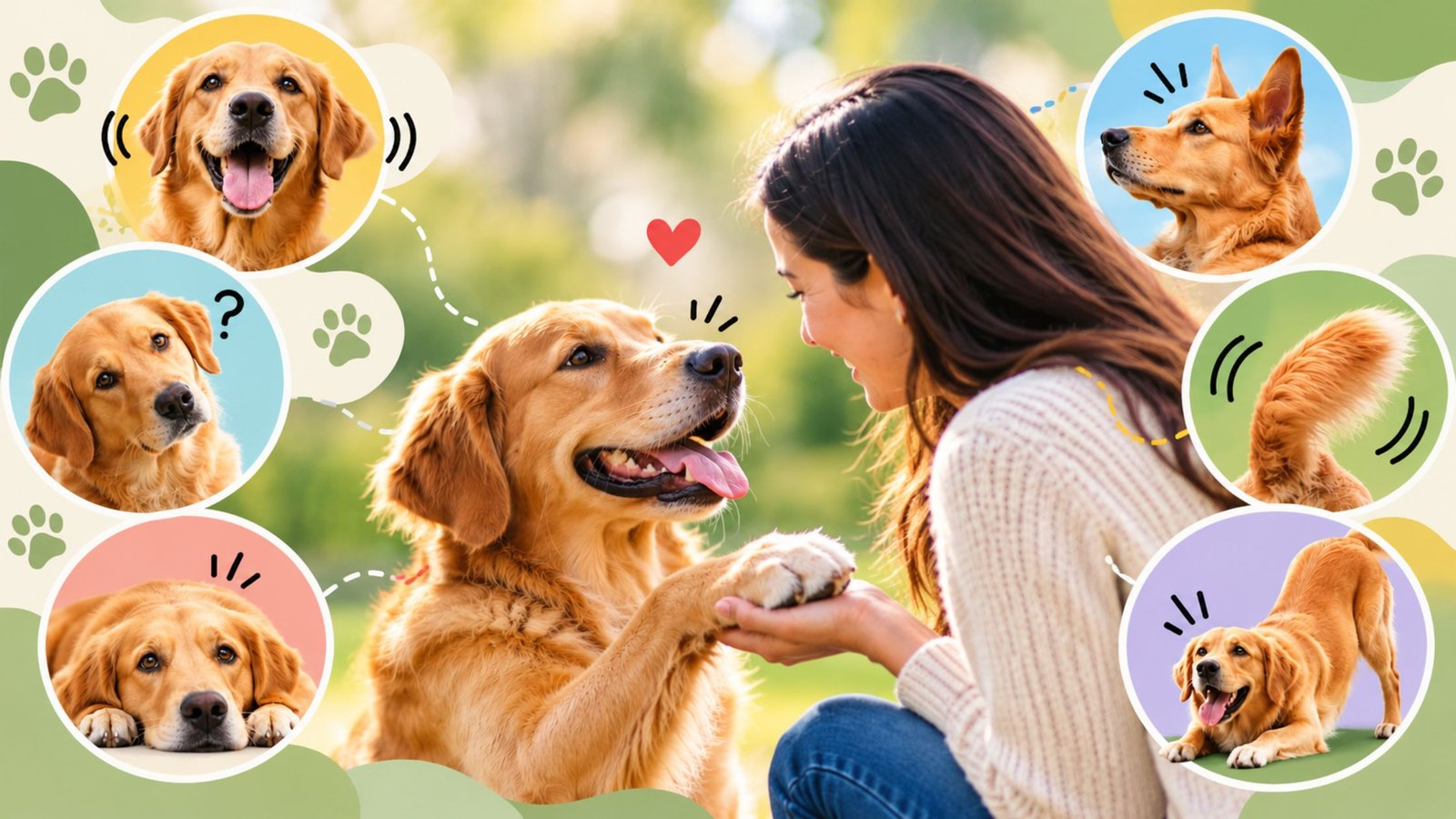
Your dog stares at you while you eat dinner. Then she sighs, flops down, and looks away. Was that boredom? Annoyance? A hint that her bowl is empty?
Here’s the short answer: dogs communicate with humans mostly through body language, sounds, eye contact, and behavior, not words. Once you learn to read the signals, you’ll understand your dog much better and avoid a lot of frustration on both sides.
In this guide, you’ll learn what your dog’s ears, tail, eyes, mouth, and voice are really saying, which signals owners commonly misread, and when a change in communication means it’s time to call the vet.
Quick Answer: Key Takeaways
- Dogs speak mainly through body language. Sounds come second.
- Read the whole dog, not just one part. A wagging tail doesn’t always mean “happy.”
- Yawning, lip licking, and looking away are often stress signals, not boredom.
- A growl is a warning, not bad behavior. Never punish it.
- Sudden changes in how your dog communicates can signal pain or illness. Talk to your vet.
Why Understanding Your Dog’s Communication Matters
Dogs and humans have lived together for thousands of years. Over that time, dogs became remarkably good at reading us. They follow our pointing, notice our tone of voice, and watch our faces for cues.
The problem is that we’re not always as good at reading them. And when we miss the message, small issues can grow. A dog who is quietly saying “I’m uncomfortable” may eventually have to say it louder, with a growl or a snap.
Learning how to understand your dog helps you:
- Prevent stress and bite incidents
- Build trust and a stronger bond
- Train more effectively
- Catch health problems earlier
- Make your dog feel safe and understood
How Dogs Communicate: The Main Channels
Dogs use several “channels” at once. To understand them, look at all of them together.
| Channel | What It Includes | Example |
|---|---|---|
| Body posture | Stance, weight shift, muscle tension | Stiff, still body vs. loose, wiggly body |
| Face | Eyes, ears, mouth, brows | Soft eyes vs. hard stare |
| Tail | Height, speed, direction | High and stiff vs. low and relaxed |
| Voice | Barks, whines, growls, howls | High-pitched bark vs. low rumbling growl |
| Eye contact | Gazing, looking away | Soft gaze vs. staring |
| Actions | Nudging, pawing, bringing items | Dropping a toy in your lap |
| Scent | Sniffing, marking | Sniffing a spot for a long time |
Dog Body Language: What the Parts Are Saying
The Tail
Most people know the wagging tail, but it’s more nuanced than “happy dog.” A wag means your dog is emotionally aroused. That arousal can be joy, excitement, nervousness, or even tension.
Watch these details:
- Loose, sweeping wag with a wiggly body: Friendly and relaxed.
- High, stiff, fast wag: Alert or aroused. Pay attention to the rest of the body.
- Low or tucked tail: Fear, stress, or insecurity.
- Neutral, relaxed tail: Calm. (Every dog’s “normal” tail position is different.)
Some research suggests the direction of the wag may also carry meaning for other dogs, but you’ll get far more useful information from the speed, height, and stiffness of the wag.
The Ears
Ears move constantly and tell you where your dog’s attention is.
- Relaxed, neutral position: Comfortable.
- Forward and perked: Interested or alert.
- Pinned back or flattened: Fear, appeasement, or stress.
- One ear up, one ear back: Mixed feelings or listening to different sounds.
Breeds with floppy ears or cropped ears can be harder to read, so learn your own dog’s normal baseline.
The Eyes
Eyes are a window into your dog’s mood.
- Soft, squinty eyes: Relaxed and friendly.
- Hard, direct stare: Can signal tension or a challenge. Avoid staring back.
- Whale eye: You can see the whites of the eyes, often with the head turned away. This is a common sign of stress or discomfort.
- Slow blinking: Often a calm, friendly signal.
Eye contact between dogs and their owners is special. Research from Japan suggests that mutual gazing between dogs and owners may be linked to rising oxytocin, the bonding hormone, in both. In plain terms, when your dog gazes softly at you, she’s likely strengthening your bond.
The Mouth
- Soft, slightly open mouth: Relaxed.
- Tightly closed mouth: Tension or concentration.
- Lip licking, when no food is nearby: Nervousness.
- Yawning when not tired: Often a stress or calming signal.
- Lip curl or showing teeth: A clear warning to back off.
The Whole Body
- Play bow: Front end down, rear end up. This means “Let’s play!”
- Loose, wiggly body: Happy and relaxed.
- Stiff, frozen posture: Tension. Something may be about to happen.
- Leaning away or turning the body away: Discomfort.
- Rolling over and showing the belly: Can mean “I’m relaxed,” or “Please don’t be scary.” Context matters.
- Shaking off when not wet: Often a way to release stress after an intense moment.
What Do Dog Barks and Sounds Mean?
Barking isn’t just noise. Dogs vary pitch, rhythm, and repetition to send different messages. No two dogs are exactly alike, but here are general patterns.
- Barking: Alerting you to something, excitement, frustration, or seeking attention. A rapid, high-pitched bark often signals excitement. A low, slower bark may be more serious.
- Whining: Can mean “I want something,” anxiety, excitement, or pain.
- Howling: Long-distance communication, loneliness, or a response to sirens and other sounds. Some breeds are especially vocal.
- Growling: A warning. It means “I’m uncomfortable. Please stop.”
- Sighing: A long sigh while lying down usually means contentment. Sighing with a tense body may mean frustration.
- Grumbling or “talking”: Many dogs mutter and groan during play or when they want your attention.
Please Don’t Punish a Growl
This is one of the most important things you can learn. A growl is your dog’s way of giving you fair warning. If you scold a dog for growling, she may learn to skip the warning and go straight to a bite.
Instead, take the growl seriously. Calmly remove your dog from the situation or create distance, figure out what triggered it, and talk to a professional if it happens often.
How Dogs Try to Communicate With You Specifically
Dogs behave differently with people than they do with other dogs. Many of the signals below developed through living with us.
- Staring at you: Often a request for food, a walk, or attention. Or simply a sign of connection.
- Bringing you a toy: An invitation to play or a gift to share.
- Pawing at you: “Pay attention to me.” It works, which is why dogs repeat it.
- Leaning on you: Seeking closeness and comfort.
- Following you room to room: Attachment and curiosity.
- Nudging your hand with their nose: “Keep petting me.”
- Bringing their leash to the door: “Walk time, please.”
- Following your pointing finger: Dogs are unusually skilled at understanding human pointing, even compared with many other animals.
- Head tilting: Often seen when dogs listen closely to us. Scientists don’t fully know why dogs do it, but many owners see it when they say a familiar word or make an interesting sound.
Signs Your Dog Is Stressed (That Many Owners Miss)
Stress signals are quiet. Learn them, and you can step in early.
- Yawning, lip licking, or nose licking
- Turning the head away or avoiding eye contact
- Whale eye
- Panting when it isn’t hot
- Shaking off when dry
- Pacing or hiding
- Ears pinned back and tail tucked
- Sudden scratching or sniffing the ground in an unrelated moment
- Refusing a treat they’d normally love
One signal on its own doesn’t always mean stress. A dog might yawn simply because she’s sleepy. Look for clusters of signals and consider the situation.
Normal vs. Concerning Communication
| Normal | Worth Watching |
|---|---|
| Occasional barking at the doorbell | Constant barking or howling that’s new |
| Short whining at feeding time | Whimpering when touched or moving |
| A playful growl during tug | A tense, stiff growl near food or toys |
| Relaxed body, soft eyes | Hiding, freezing, or avoiding people |
| Seeking attention in the evening | Sudden clinginess or withdrawal |
What to Do at Home: A Simple Plan
- Learn your dog’s baseline. Notice how your dog looks when she’s relaxed. Ear and tail position, breathing, and body tension vary by dog and breed.
- Watch the whole dog. Read the tail, ears, eyes, mouth, and posture together.
- Notice the context. The same signal can mean different things in different settings.
- Respond to the quiet signals. If your dog looks away or yawns when a stranger approaches, give her space before she has to say it louder.
- Reward calm behavior. Praise or treat your dog when she’s relaxed, not just when she’s active.
- Keep your own signals clear. Use consistent words, calm tone, and relaxed body language. Dogs read your posture and voice too.
- Take short videos. Slow-motion replays help you catch subtle signals you missed in the moment.
Breed, Age, and Size Differences
Not all dogs “speak” the same way.
- Flat-faced breeds (like Bulldogs and Pugs) have less expressive faces and can be harder to read.
- Dogs with docked tails or very curly tails may show less tail movement, so watch the body more closely.
- Husky-type breeds are famously vocal and may “talk” a lot.
- Herding breeds can be intense starers and may nip or circle when excited.
- Puppies are still learning their signals and may be over the top. Be patient.
- Senior dogs may communicate more through withdrawal, restlessness, or changes in sleep, often related to comfort or health.
- Large dogs and small dogs speak the same language. But small dogs’ warnings are often brushed off, which can make them feel they need to escalate.
Common Mistakes Owners Make
- Assuming a guilty look means guilt. Research on this shows dogs often show the “guilty look” in response to an owner’s scolding tone or posture, not because they understand what they did wrong.
- Hugging every dog. Many dogs find hugs stressful. Some tolerate them, but look for stiffening, lip licking, or turning away.
- Punishing growling. It removes the warning without fixing the cause.
- Reading only the tail. A wag can come with fear or tension.
- Staring down a dog. A hard stare can feel threatening.
- Ignoring subtle signals. Dogs usually whisper before they shout.
- Pushing a nervous dog to “say hello.” Let your dog choose.
- Misreading play. Play can look rough. Look for loose bodies, play bows, and taking turns.
What Most People Miss
Your dog is also reading you. Your tone, your body, your tension, and your routine all send messages. If you’re anxious on walks, your dog may become more alert. If you’re calm and consistent, she’ll often settle more easily.
Better communication is a two-way street. Learning her language and keeping your own signals clear will do more for your relationship than any gadget.
A Real-Life Example
Consider Charlie, a 4-year-old Beagle mix. His owner noticed he started licking his lips, turning away, and walking slowly whenever a neighbor’s friendly Labrador came near. She used to think Charlie was just “shy.”
After learning about stress signals, she began crossing the street early and rewarding Charlie for calm behavior at a distance. Within a few weeks, Charlie stopped freezing and started watching the other dog with a softer body. He hadn’t changed. His owner had simply started listening.
When to Call the Vet or a Professional
Communication changes can signal health problems. Call your vet if your dog:
- Suddenly becomes more vocal, withdrawn, or irritable
- Yelps when touched or picked up
- Stops eating or drinking
- Shows changes in sleep, restlessness, or pacing
- Has repeated growling or snapping, especially if it’s new
- Hides more than usual
Pain, hearing loss, vision changes, and cognitive decline can all change how a dog behaves. For ongoing aggression, intense fear, or separation anxiety, ask your vet for a referral to a certified trainer or a veterinary behaviorist.
Frequently Asked Questions
How do dogs communicate with humans?
Dogs communicate mainly through body language, including tail, ears, eyes, mouth, and posture. They also use sounds like barks, whines, and growls, and actions like nudging, pawing, and bringing toys. Reading these signals together gives you the clearest picture of what your dog is feeling.
What does it mean when a dog stares at you?
A soft stare often means affection or a request, such as food, a walk, or attention. A hard, stiff stare can signal tension. Look at the rest of the body. Relaxed ears and a loose posture usually mean your dog is simply connecting with you.
Do dogs understand human words?
Many dogs learn the meaning of dozens of words and phrases, especially those tied to routine, like “walk” or “treat.” They also respond strongly to tone of voice and body language, so what you say and how you say it both matter.
Why does my dog tilt her head when I talk?
No one knows for sure. Many experts think it may be a way of listening more closely or reading your face. It’s usually harmless. If the tilt is constant or comes with balance trouble, check with your vet.
Is a wagging tail always a sign of a happy dog?
No. A wag shows emotional arousal, which can be happiness, excitement, nervousness, or tension. Look at the speed, height, and stiffness of the wag, along with the ears, eyes, and posture, before assuming your dog is friendly.
Conclusion
Understanding how dogs communicate with humans takes practice, but it pays off every day. Watch the whole dog, notice the quiet signals, and respond early. When you listen to what your dog is already telling you, she trusts you more.