
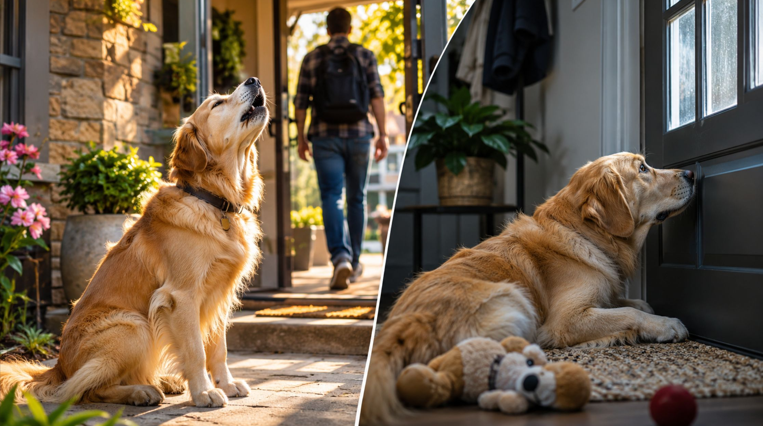
The first time I heard it, I thought someone was hurt.
I had just left my apartment to grab coffee. I was halfway down the hallway when a long, mournful howl echoed through the door. It was my dog, Cooper. A 4-year-old hound mix I had adopted three weeks earlier.
I froze. My heart dropped. I ran back inside, expecting to find him bleeding or trapped.
Instead, I found him sitting on the couch, head tilted toward the ceiling, letting out a sound that was part wolf, part broken kazoo. He looked at me like, “Oh, you’re back. That was fast.”
I laughed. Then I got worried. Then I spent the next three weeks obsessively watching him on a camera, trying to figure out: Is he sad? Is he anxious? Is he just… singing?
If you’re reading this, you’ve probably had a similar moment. You grab your keys, walk out the door, and within 60 seconds, your dog starts their “goodbye song.” Maybe it’s a low, rumbling howl. Maybe it’s a high-pitched whine that turns into a howl. Maybe it’s a full-on opera performance that your neighbors have started texting you about.
And you’re left wondering: Is this normal? Is he heartbroken? Do I need to call a trainer? A vet? An exorcist?
I’ve been there. After eight years of working with dogs—from anxious Chihuahuas to howling Huskies—I’ve learned that a dog howling when you leave can mean about six different things. Some are totally fine. Some are a cry for help.
Let me help you decode your dog’s goodbye song.
First, Let’s Talk About Why Dogs Howl At All
Before we figure out why your dog howls when you leave, we need to understand howling itself. Because howling isn’t the same as barking. It’s older. More primal. And honestly? Kind of beautiful.
Howling is wolf heritage. Thousands of years ago, wolves howled to:
- Locate pack members who had wandered off
- Warn rival packs to stay away
- Coordinate hunting
- Express emotional states (excitement, loneliness, anxiety)
Your dog’s brain still has those wolf circuits. When they howl, they’re speaking an ancient language. The question is: What are they saying?
The 6 Types of Howls
| Locator howl | Single, rising note, then silence | “Where are you?” |
| Response howl | Matches pitch of a sound (siren, another dog) | “I hear you, I’m here” |
| Separation howl | Long, mournful, repetitive | “I’m alone and I don’t like it” |
| Excitement howl | Short, higher-pitched, often with tail wagging | “Yay! Something’s happening!” |
| Attention howl | Starts as a whine, builds to howl, looks at you | “Hey. Hey. Look at me.” |
| Compulsive howl | Same pitch, same duration, over and over | “I can’t stop doing this” |
Most dogs who howl when their owner leaves are doing either a separation howl or a locator howl. One is concerning. The other is actually pretty sweet.
Let me explain.
The 5 Reasons Your Dog Howls When You Leave
After listening to hundreds of client videos (and watching way too many hours of Cooper on a pet camera), I’ve narrowed this down to five main reasons.
Reason 1: The Locator Howl (“Where did you go?”)
This is the most common reason. And it’s usually not a problem.
What’s happening: Your dog knows you left. They heard the door close. They heard your footsteps fade. But they don’t know where you went or when you’re coming back. So they howl—the ancient wolf signal for “I’m here, where are you?”
What it sounds like: A single, rising howl. Then silence. Then another single howl a minute later. They’re not panicking. They’re just… checking in.
The body language: Your dog is usually calm otherwise. They might be lying on the couch or standing by the door. Their tail might be down but not tucked. They’re not pacing, drooling, or destroying things.
Is this a problem? No. This is normal canine communication. Some breeds do it more than others (more on that below). It usually stops within 5-10 minutes of you leaving.
Real story: My neighbor’s Husky, Koda, does this every single morning. She leaves for work at 8 AM. Koda lets out exactly three howls, spaced about 90 seconds apart. Then he goes to sleep on the couch. He’s not anxious. He’s just saying “bye, see you later.”
Reason 2: The Response Howl (“The siren started it!”)
Some dogs howl because something else triggered them, and you leaving just happened to be nearby.
Common triggers:
- Fire trucks, ambulances, or police sirens.
- Other dogs are howling in the neighborhood.
- Musical instruments (harmonicas, pianos, certain songs).
- Appliances (vacuum cleaners, hair dryers).
What’s happening: Your dog hears a high-pitched, sustained sound. Their wolf brain says, “That sounds like a howl. I must answer.” They howl back. You just happen to be walking out the door at the same time.
How to tell: Watch your dog right before you leave. Do they howl at the sound of your keys jingling or the door creaking? That’s not a response howl. If they howl after a siren passes? That’s a response howl.
Is this a problem? No. It’s a reflex. Some breeds (Huskies, Beagles, Coonhounds) are genetically programmed to howl in response to sounds.
Reason 3: Mild Separation Anxiety (The “I don’t like this” Howl)
This is where we start getting into concerning territory.
What’s happening: Your dog isn’t panicking, but they’re not comfortable either. They don’t like being alone. It makes them feel uneasy. The howl is an expression of that low-level distress.
What it sounds like: The howl is repetitive—every 30-60 seconds. It might start as a whine, then build into a howl. It continues for more than 10 minutes. It has a mournful, sad quality.
The body language: Your dog might pace a little. They might stare at the door. They might pant slightly or have slightly dilated pupils. But they’re not destructive. They’re not drooling. They’re not hurting themselves.
Is this a problem? It’s a yellow flag. Not an emergency, but something to work on. Mild separation anxiety can get worse over time if ignored. But it’s also very treatable.
How to tell the difference: A dog with mild anxiety will usually settle down within 20-30 minutes. A dog who’s just “checking in” (Reason #1) stops howling much faster—usually within 5-10 minutes.
Reason 4: Full-Blown Separation Anxiety (The Red Flag)
This is the one that needs professional help.
What’s happening: Your dog is panicking. Their body is in fight-or-flight mode. They’re not choosing to howl—they can’t stop howling. It’s a stress response, not a communication choice.
What it sounds like: Constant howling, whining, or barking for hours. The howl might be mixed with yelps or shrieks. It doesn’t stop when you’re gone. It only stops when you come back.
The body language (on camera):
- Pacing in circles or back and forth
- Drooling excessively
- Destructive behavior (chewing door frames, scratching windows)
- House soiling (even if they’re housetrained)
- Trying to escape (digging at doors, jumping at windows)
- Self-injury (raw paws from scratching, broken teeth)
Is this a problem? Yes. This is a medical and behavioral emergency. Not “call 911” emergency, but “call a vet and a certified separation anxiety trainer this week” emergency.
Real story: A client had a Border Collie named Ziggy who howled for 6+ hours every day while she was at work. He also chewed through a wooden door. Twice. He wasn’t being “bad.” He was having panic attacks. With medication and behavior modification, he improved dramatically. But it took months.
Reason 5: Breed Predisposition (Some Dogs Just Howl)
Here’s the honest truth: Some breeds are howlers. It’s not anxiety. It’s not a problem. It’s just who they are.
Breeds most likely to howl:
- Siberian Huskies
- Alaskan Malamutes
- Beagles
- Basset Hounds
- Bloodhounds
- Coonhounds
- German Shepherds (some lines)
- Dachshunds (surprisingly!)
What’s happening: These breeds were selectively bred for howling. Huskies howled to communicate across long distances. Hounds howled to alert hunters that they’d treed an animal. It’s not a bug—it’s a feature.
How to tell if it’s breed vs. anxiety: A howling breed will howl at lots of things, not just your departure. They howl at sirens. They howl at the doorbell. They howl just because it’s Tuesday. And they usually stop howling within a few minutes of you leaving because they get bored.
An anxious dog howls specifically when you leave and doesn’t stop.
The 5-Question Test: Is Your Dog Anxious or Just Vocal?
I give this checklist to all my clients. Answer honestly.
| Does your dog howl within 5 minutes of you leaving? | ||
| Does the howling continue for more than 20 minutes? | ||
| Does your dog show other stress signs (pacing, drooling, destruction)? | ||
| Does your dog ignore treats or toys when you’re gone? | ||
| Does your dog seem exhausted or “off” when you return? |
Scoring:
- 0-1 Yes: Probably normal howling. Your dog is just vocal.
- 2-3 Yes: Mild separation anxiety. Start training now before it gets worse.
- 4-5 Yes: Moderate to severe separation anxiety. Call your vet and a trainer this week.
Cooper scored a 1. He howled within 5 minutes (yes), but stopped after 8 minutes (no to #2). No destruction, no drooling. He took treats. He was fine when I got home. He’s just a vocal guy.
How to Stop the Howling (Based on the Cause)
You can’t fix the problem until you know what the problem is. Here’s what works for each scenario.
If Your Dog Has Mild Anxiety (Reasons #3):
Step 1: The “Pretend to Leave” Game
This is the gold-standard treatment for mild separation anxiety.
- Pick up your keys. Put them down. Sit down. (Do this 10 times until your dog stops reacting)
- Pick up keys, walk to the door, touch the handle, come back. (10 times)
- Open the door, step outside, close the door, immediately come back in. (10 times)
- Stay outside for 5 seconds. Come back.
- Stay outside for 15 seconds. Come back.
- Stay outside for 30 seconds. Come back.
You’re teaching your dog that “owner leaving” always leads to “owner returning.” Do this every day for 10 minutes. Increase duration slowly.
Step 2: Give a “Departure Cue” Treat
Give your dog a high-value, long-lasting treat only when you leave. Frozen Kong. LickiMat. Stuffed chew toy.
The goal: Your dog starts to think “keys = peanut butter time” instead of “keys = panic time.”
Step 3: Use a Camera (But Don’t Obsess)
Get a pet camera (I use Wyze or Furbo). Watch for 5 minutes after you leave. If your dog settles down, great. If they’re still howling after 15 minutes, you need a trainer.
If Your Dog Has Severe Anxiety (Reason #4):
You need professional help. I’m serious. Do not try to DIY this.
Step 1: Vet visit. Rule out medical causes (pain, thyroid issues, cognitive decline). Discuss medication. Trazodone, fluoxetine, or clomicalm can be life-changing.
Step 2: Find a CSAT (Certified Separation Anxiety Trainer). Look for trainers with “CSAT” credentials. They specialize in this exact problem.
Step 3: Don’t leave your dog alone. I know this sounds impossible. But every time a dog with severe anxiety practices howling and panicking, the behavior gets more entrenched. Find a dog sitter, daycare, or friend. Even 30 minutes of panic sets back weeks of training.
If Your Dog Is Just Vocal (Reasons #1, #2, or #5):
You don’t need to “fix” this. Your dog is fine. But if the howling is annoying your neighbors or waking up your baby, here are some management tips:
Tip 1: Mask the Triggers
- Leave a white noise machine or fan running.
- Play classical music or “DogTV.”
- Close windows to block siren sounds.
Tip 2: Give a “Howl Alternative”
Teach your dog to “speak” (howl on command) and then teach “quiet.” This gives you control over the behavior.
How to teach “quiet”:
- Trigger a howl (knock on the door, play a siren sound on your phone)
- The moment they stop howling (even for a second), say “quiet” and give a treat
- Repeat. Gradually increase the time they must stay quiet before the treat
Tip 3: Accept Your Howling Dog
Some dogs just howl. Cooper still howls when I leave. He’s 8 years old now. I’ve accepted that this is his way of saying “I love you, come back soon.” It’s not a problem. It’s his personality.
What About Howling at Night or When You’re Home?
This article is about howling when you leave. But if your dog howls at night or when you’re in the house, that’s a different conversation.
Night howling (while you’re home):
- Could be sundowning (cognitive dysfunction in senior dogs)
- Could be hearing distant sirens or other dogs
- Could be boredom or attention-seeking
Howling when you’re home:
- Usually attention-seeking (“play with me”)
- Or response to a trigger (doorbell, phone ringing)
- Or medical (pain, hearing loss)
If your dog howls constantly regardless of whether you’re there or not, start with a vet visit.
The “Silent Howl” Phenomenon
One more thing before we wrap up.
Some dogs don’t make noise when they howl. They lift their head, open their mouth, and… nothing comes out. Or just a tiny puff of air.
This is called a silent howl. And it’s adorable.
Why do dogs silent howl?
- They’re trying to howl but don’t have the lung capacity (brachycephalic breeds like Pugs and Bulldogs)
- They’ve learned that loud howling gets them in trouble, so they’re “whispering.”
- They’re old or have laryngeal paralysis.
- They’re just weird (valid reason)
If your dog is silent howls when you leave, they’re still anxious or communicating. The lack of sound doesn’t mean lack of feeling. Use the same guidelines above.
FAQ
Is it cruel to leave a howling dog alone?
That depends on why they’re howling. A dog with separation anxiety is genuinely distressed, and leaving them alone for long periods is stressful (like leaving a person having a panic attack alone). A dog that howls for 5 minutes and then sleeps is fine. If you’re unsure, set up a camera and watch for other signs of distress.
Will getting another dog stop the howling?
Usually not. Separation anxiety is about you leaving, not about being alone. A second dog might help with boredom, but anxious dogs often teach the new dog to be anxious. Now you have two howling dogs. Ask me how I know.
My dog only howls when I leave for work, not when I run errands. Why?
Routine. Your dog knows the difference between “owner grabbing keys at 8 AM” (long absence) and “owner grabbing keys at 7 PM” (short absence). The howling is worse for longer absences because the anxiety has time to build.
Can I train my dog to howl less without a trainer?
For mild cases, yes. Use the “pretend to leave” game and departure treats. For moderate to severe cases (destruction, self-injury, hours of howling), you need a CSAT trainer. This is not a DIY situation.
My dog only howls when I leave my partner, but not when I leave. What does that mean?
Your dog is more attached to you. They’re fine when you leave because your partner is still there. But when your partner leaves? They’re alone with their least-favorite human (or no human). This is normal. It doesn’t mean your partner is a bad owner. It means your dog has favorites.
Do dogs howl because they’re in pain?
Sometimes. Sudden onset of howling in a senior dog (especially at night or when moving) can indicate pain. Arthritis, dental disease, or internal issues can cause vocalization. If your older dog suddenly starts howling when you leave—and they never did before—start with a vet visit.
Final Thoughts: Listening to the Song
Cooper still howls when I leave. He’s 8 years old now, gray around the muzzle, and he has never once had separation anxiety. He’s just a singer.
I’ve learned to love it.
When I’m walking to my car, and I hear that distant, mournful howl through the closed door, I smile. It’s not a cry of despair. It’s his way of saying, “I noticed you’re gone. I’ll be here when you get back. Don’t forget the good treats.”
Your dog’s goodbye song might be different. It might be a gentle locator howl. It might be a siren response. It might be a red flag for anxiety. Only you—and maybe a camera—can tell the difference.
But here’s what I want you to take away: Your dog isn’t howling to annoy you or your neighbors. They’re communicating in the oldest language on earth.
Listen to them. Learn what they’re saying. And if they’re struggling? Get help. There’s no shame in a dog who needs a little extra support.
Cooper is snoring next to me as I type this. In about an hour, I’ll grab my keys to get groceries. He’ll lift his head, watch me, and the moment the door closes?
Awooooooo.
And honestly? I wouldn’t have it any other way.