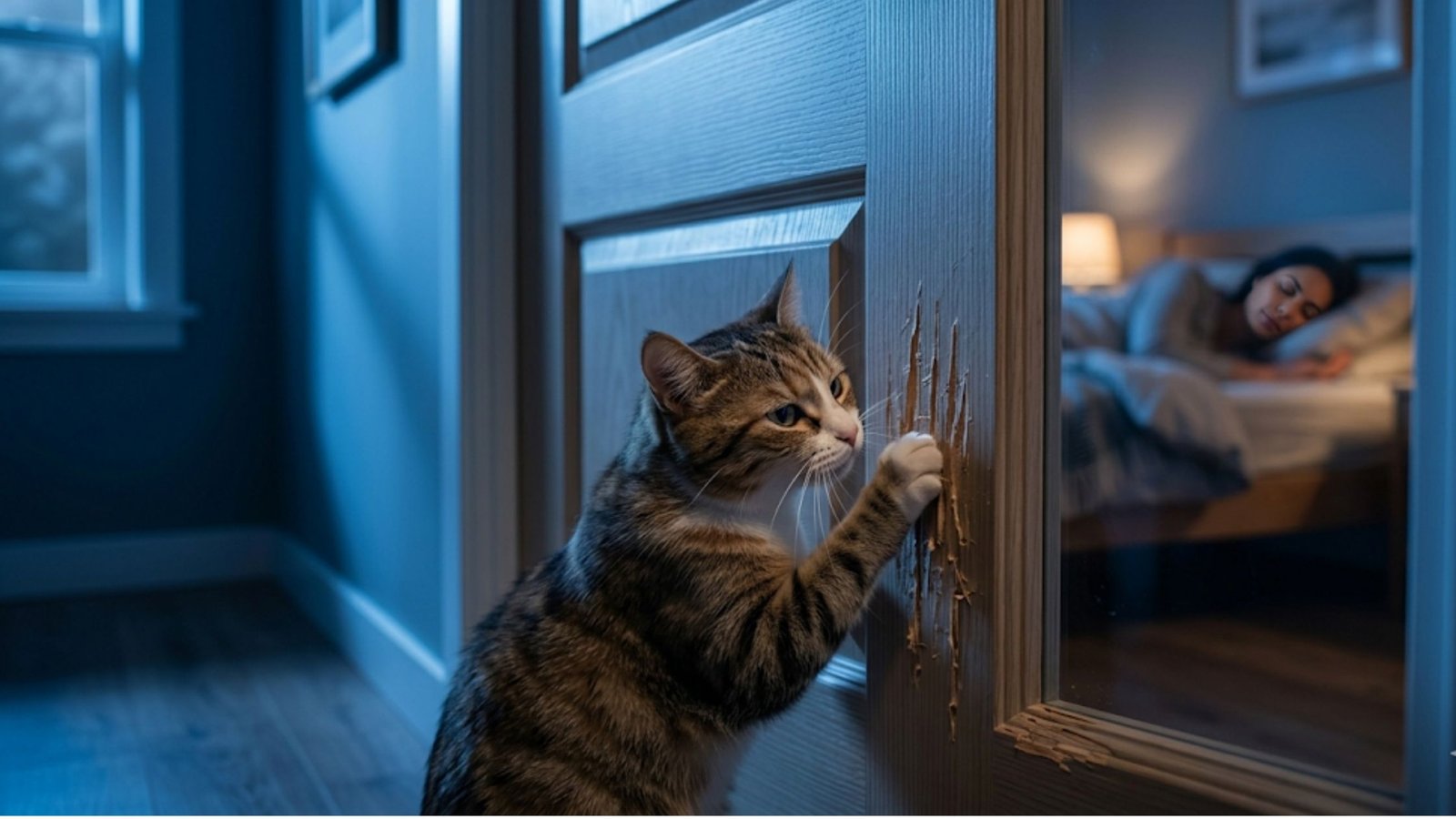
If your cat keeps you up at night by scratching at the door, you’re not alone. This is probably the most common complaint among cat owners.
The good news is that this behavior can be corrected – and it doesn’t require scaring, spraying, or punishing the cat. Cats don’t learn anything from punishment; they just become afraid of you.
In this article, I’ll share 5 humane and practical solutions that I’ve tried over the years of cat behavior consulting. These methods are simple, can be implemented right at home, and have been proven to be effective on most cats.
So, let’s first understand why cats do this, and then look for solutions.
Why Do Cats Scratch Doors at Night?
Before finding a solution to any problem, it is important to understand the cause. Cats scratch doors not because they are “bad”. There are four main reasons behind it:
- Attention seeking: the cat has learned that scratching means you open the door or talk to them.
- Boredom and excess energy: Cats are most active in the morning and evening. If they don’t get enough activity during the day, they need to release that energy somewhere at night.
- Separation anxiety: Some cats don’t like closed doors. They feel like you are away from them and they get stressed.
- Natural instinct: Cats have an innate need to scratch. It exercises their paws, rubs their nails, and marks their territory.
Now that we understand these reasons, let’s move on to the solutions.
5 Humane Ways to Stop the Night Scratching
All five of these methods have been tried and tested and work. Try them one by one to see which one works best for your cat.
1. Give Her a Better Place to Scratch
To stop your cat from scratching, give her a different place. Saying “do this” is more effective than saying “no.”
How to do it:
- Place a tall scratching post next to the door. At least 30-32 inches is best, as cats like heights.
- Rub catnip or silvervine on the post. This will make it more attractive.
- Whenever your cat uses the post, immediately give her a treat or praise.
The advantage of this method is that it satisfies the cat’s natural need and keeps your door safe.
2. Break the Attention Loop with Ignoring
The cat scratches the door because it wants your attention. If you open the door, talk to it, or yell at it, you are teaching it that this behavior works.
How to do it:
- Make sure all of the cat’s needs are met – food, water, litter box is clean.
- When the scratching starts, completely ignore it. Don’t open the door. Don’t yell at it. Don’t even move.
- The first 2-3 nights will be worse. The cat will scratch even louder. This is normal. It is saying, “You used to come before, why don’t you come now?”
- If you give up at this point and open the door, the cat will learn that scratching harder = the door will open.
After 5-7 days of continuous ignoring, most cats understand that this no longer works.
3. Tire Her Out with Pre-Bedtime Play
Cats are active at night, but if you use their energy properly before going to bed, they will fall asleep exhausted.
How to do it:
- Play with your cat for 20-25 minutes before going to bed.
- Use a wand toy (a rod with a rope). Make the cat run, jump, chase prey.
- Feed immediately after the game. The natural pattern is: hunt → food → sleep.
- Let the cat be quiet after the meal. It will fall asleep on its own.
This method is very effective for scratching caused by boredom.
4. Make the Door Unappealing to Scratch
If the door becomes unattractive to scratch, the cat will look for another place.
Try one of these:
| Contents | How to use |
| Double-sided tape | Apply to the bottom of the door. Cats don’t like sticky surfaces. |
| Aluminum foil | Spread it out in front of the door for a few days. Cats don’t like the sound and feel of foil. |
| Scratch guard | Plexiglass door guards are available in the market. They keep the door safe and the cat cannot scratch it. |
| The door is slightly open. | If possible, leave the door open enough for the cat to come and go. Many cats are calmed down simply by knowing that the door is not closed. |
5. Create a Calm Nighttime Routine
Cats feel secure in routine. If they know what to expect at night, their anxiety will decrease.
A simple routine might look like this:
| Time | What to do? |
| 10:00 PM | 20 minutes of play (wand toy) |
| 10:30 PM | Give food. |
| 10:45 PM | Check the litter box (must be clean) |
| 11:00 PM | Place his bed, water, toys outside the door. |
| 11:15 PM | You go to sleep. The door is closed (or slightly open). |
Extra tip: If your cat is stressed, use a pheromone diffuser like Feliway. It helps keep cats calm.
Follow this routine consistently for 7-10 days. You will start seeing a difference.
H2: What Doesn’t Work – And Why
Many owners make some mistakes with good intentions. Avoid these:
| What not to do | Why it doesn’t work |
| Sprinkle water | The cat starts to be afraid of you, but doesn’t stop scratching. Your trust is broken. |
| Shouting | Cats also perceive shouting as attention. They will meow more. |
| Incompatibility | Ignore one night, open the door the next – this confuses the cat. |
| Not having a scratching post | Cats have a natural need to scratch. If there is no suitable place, they will scratch the door. |
FAQ
1. Why does my cat scratch at the door at night?
The main reasons are: attention seeking, boredom, excess energy, separation anxiety, or a natural need to scratch.
2. Isn’t it cruel to ignore a cat at night?
If you make sure that all its needs (food, water, litter box) are met, then ignoring is not cruel. It is an effective training method. But if the cat is sick, don’t ignore it.
3. What does spraying water do?
Spraying water doesn’t stop a cat from scratching – it just makes it afraid of you. This can damage your relationship.
4. How many days will it take to see a difference?
Some cats understand in 3-5 days, while others may take 2-3 weeks. The key is consistency – respond in the same way every day.
5. Does Feliway really work?
Yes, I have found Feliway to be effective in many cases. It reduces anxiety and keeps cats calm. It is especially helpful if your cat is stressed (new home, new member, etc.).
6. Should you let your cat sleep in your bedroom?
It’s your choice. If you don’t mind, leaving the door open is the easiest solution. If not, try the methods above.
Final Words
Dealing with a cat scratching at the door at night can be exhausting. But the good news is that this behavior can be corrected humanely.
The five methods in this article – scratching posts, ignoring, bedtime games, making the door unattractive, and a consistent routine – are all simple, practical, and proven.
Remember one thing: your cat isn’t doing this to annoy you. He’s doing it because he wants something. Your job is to figure out what it is and provide an alternative.
Be patient, be consistent. In a few days, you’ll both be sleeping peacefully.
Now it’s your turn. Which of these methods will you try first? Let us know in the comments below.
🐾 Good luck, and sweet dreams!