
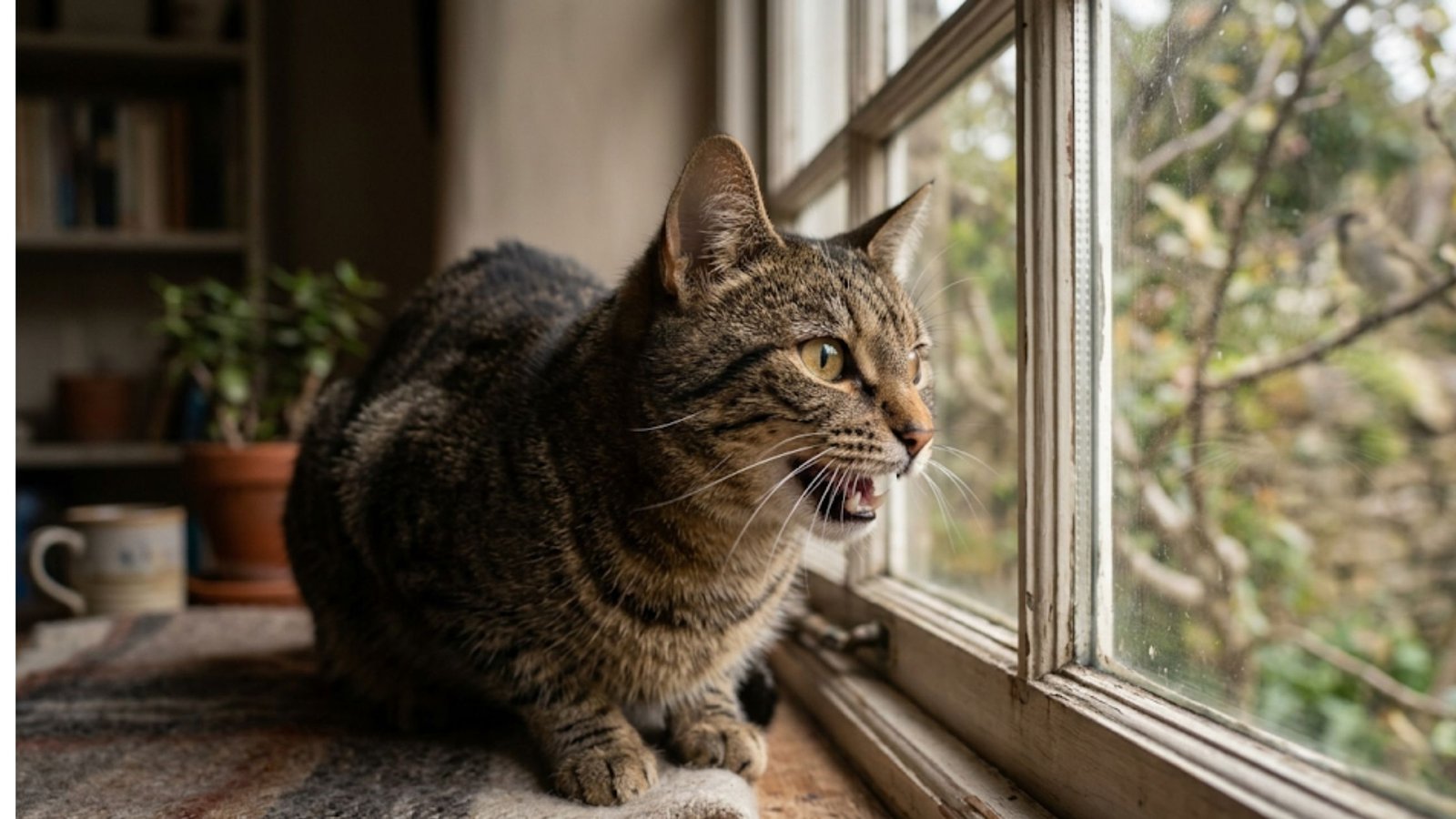
The first time I saw my cat Luna do it, I thought she was having a seizure.
I was sitting on the couch, reading, when she jumped onto the windowsill. Outside, a squirrel was taunting her from the bird feeder. Luna’s body went low. Her tail started twitching. Her pupils dilated into huge black saucers.
And then her jaw started quivering. A rapid, almost vibrating chatter. Clickclickclickclickclick. Her teeth tapped together like tiny castanets. She made a strange little chirping sound, almost like a bird mixed with a broken toy.
I panicked.
I grabbed my phone and started filming (because that’s what we do now—document everything). I sent the video to my vet. I texted my breeder. I called my mom, who has owned cats for 40 years.
My mom laughed at me. “Honey,” she said, “that’s just cat chattering. She’s hunting.”
The vet agreed. The breeder agreed. And I felt like an idiot.
But here’s the thing: Cat chattering looks weird. If you’ve never seen it before, it’s genuinely alarming. A cat’s jaw quivering, teeth clicking, eyes wide—it doesn’t look like a normal cat behavior. It looks like something is wrong.
So I understand why you’re here. Maybe you just saw your cat do this for the first time. Maybe you’ve seen it a hundred times but never knew what it meant. Maybe you’re worried it’s a dental problem or a neurological issue.
Let me put your mind at ease—and also tell you when you actually should worry. Because 95% of the time, chattering is perfectly normal. But 5% of the time? It’s a red flag.
What Is Cat Chattering? (The Short Definition)
Cat chattering (also called chirping, chittering, or clicking) is a rapid, repetitive movement of the jaw that causes the teeth to tap together. It often happens when a cat sees prey they can’t reach—a bird outside a window, a squirrel on a fence, a bug on the ceiling.
The cat’s mouth may be slightly open or closed. Their jaw quivers or vibrates. Sometimes they make a high-pitched chirping or chattering sound. Sometimes it’s silent.
It usually lasts 3-10 seconds. Then the cat either loses interest or gets frustrated and walks away.
Chattering is NOT:
- A seizure (cats don’t chatter rhythmically during seizures—they convulse)
- Aggression (an aggressive cat hisses, growls, or swats)
- A dental emergency (usually—more on this later)
Now let me explain what’s actually happening inside your cat’s brain.
The Hunting Instinct Theory (What Most Experts Believe)
The vast majority of cat behaviorists agree: chattering is a hunting behavior. But why do cats chatter? There are three main theories.
Theory 1: The “Kill Bite” Practice
This is the most widely accepted explanation.
What’s happening: When a cat catches prey (a mouse, a bird, a large bug), they deliver a final kill bite to the back of the neck. This bite severs the spinal cord. It’s quick, efficient, and requires precise jaw placement and timing.
When your cat chatters at a bird they can’t reach, they’re practicing that kill bite. Their brain is saying “I want to bite that thing right now.” Their jaw is rehearsing the motion. The teeth clicking together is the sound of a predator in training.
Why this makes sense: The chattering motion is exactly the same motion a cat makes when delivering a kill bite. Rapid, small, precise jaw movements.
Real story: I watched Luna catch a mouse once (horrifying, but educational). Right before she bit down, her jaw did the exact same chattering motion I’d seen her do at the window. It wasn’t frustration that time. It was the real thing.
Theory 2: Frustration (The “I Want It” Chatter)
This theory is simpler: your cat is frustrated.
What’s happening: Your cat sees prey. Their hunting instincts are fully activated. Their body is ready to pounce, chase, and kill. But there’s a window in the way. Or a screen door. Or a leash.
The chattering is an expression of that frustration. It’s like a human gritting their teeth or clenching their jaw when they can’t have something they want.
Why this makes sense: Chattering almost never happens when a cat can actually reach the prey. It only happens when there’s a barrier. The frustration is real.
Theory 3: Excitement Overflow (The “I Can’t Contain Myself” Chatter)
This is my personal favorite theory.
What’s happening: Your cat’s nervous system is overloaded with excitement. Their prey drive is at 100%. But they can’t act on it. That energy has to go somewhere. So it comes out as a jaw tremor—as a dog’s tail wagging so hard their whole body shakes.
Why this makes sense: Cats who chatter often have other “excitement overflow” behaviors—tail twitching, ears rotating, pupils dilating. The whole body is revved up. The chattering is just the most visible part.
Which Theory Is Correct?
Probably all three. Depending on the cat and the situation, chattering might be:
- Mostly practice (for young cats learning to hunt)
- Mostly frustration (for indoor cats who never catch prey)
- Mostly excitement overflow (for high-prey-drive breeds)
The important thing? None of these are health problems. Your cat isn’t in pain. They aren’t having a seizure. They’re just being cats.
Why Does My Cat ONLY Chatter at Certain Things?
Not all prey triggers chattering. Some cats chatter at birds but not mice. Some chatter at laser pointers, but not real bugs. Some only chatter at specific times of day.
Here’s why.
The “Distance” Factor
Chattering usually happens when prey is close but unreachable. A bird on the lawn 20 feet away? Probably no chatter. A bird on the windowsill 6 inches away? Chatter city.
The closer the prey, the more intense the hunting instinct. And the more intense the frustration when they can’t reach it.
The “Movement” Factor
Cats are wired to see movement. A still bird might not trigger chattering. But the moment that bird hops? Chatter.
The type of movement matters too. Erratic, unpredictable movement (a fly buzzing around) triggers more chattering than smooth, predictable movement (a squirrel walking in a straight line).
Breed Predisposition
Some cat breeds are more “chattery” than others.
High-chatter breeds:
- Siamese (very vocal, very chatty)
- Oriental Shorthairs
- Bengals (high prey drive)
- Abyssinians
- Savannahs
Low-chatter breeds:
- Persians (too chill to care)
- British Shorthairs
- Ragdolls
- Maine Coons (they hunt, but quietly)
Luna is a domestic shorthair with some Siamese in her. She chatters at birds, squirrels, bugs, laser pointers, and occasionally dust motes. She’s a talker.
When Cat Chattering IS a Health Issue (Please Read This)
I promised you honesty. Most chattering is normal. But sometimes, it’s not.
Here’s how to tell the difference.
Dental Disease (The Most Common “Fake” Chattering)
What’s happening: Your cat has dental pain—a cracked tooth, gum disease, a tooth root abscess. The pain causes jaw trembling or teeth clicking, especially when they smell food or try to eat.
How to tell the difference:
| Happens when seeing prey (birds, bugs) | Happens when smelling food or eating |
| Lasts 3-10 seconds | Can last minutes or happen randomly |
| Cat is otherwise alert and engaged | Cat may drool, paw at mouth, or eat less |
| Cat stops when prey leaves | Cat continues even when nothing is there |
| Eyes are dilated, focused | Eyes may be squinty (pain response) |
What to do: If your cat chatters when there’s NO prey visible (just food, or nothing at all), schedule a vet dental exam. Dental disease is painful and common—80% of cats over age 3 have some form of it.
Seizure Disorders (Rare but Serious)
What’s happening: A focal (partial) seizure can cause repetitive jaw movements that look like chattering. Unlike hunting chatter, the cat isn’t responsive during the episode.
How to tell the difference:
| Cat responds to your voice (“Luna! Treat!”) | Cat is unresponsive, “checked out” |
| Cat stops when prey leaves | Cat continues for 1-3 minutes regardless |
| Eyes track the prey | Eyes may be unfocused or roll |
| Cat acts normal before and after | Cat may seem confused or tired after |
What to do: If your cat doesn’t respond to you during a chattering episode, or if the episode lasts longer than 30 seconds, film it and show your vet. Seizures are treatable, but they need a diagnosis.
Feline Hyperesthesia Syndrome (The “Rolling Skin” Disease)
This is a rare neurological condition where cats have extreme skin sensitivity, usually along their back. Some cats with hyperesthesia also have jaw chattering.
Other signs of hyperesthesia:
- Rippling or rolling skin along the back
- Excessive grooming (especially the tail or flanks)
- Sudden, frantic running or “zoomies.”
- Dilated pupils
- Vocalization (yowling, not chirping)
What to do: If your cat chatters and has rippling back skin, see a vet. Hyperesthesia can be managed with medication and environmental changes.
Tremors from Toxins or Metabolic Issues
What’s happening: Your cat has ingested something toxic (lily pollen, certain houseplants, human medication) or has a metabolic issue (low blood sugar, kidney failure). Jaw tremors are one symptom.
Other signs of toxicity/metabolic issues:
- Drooling or foaming at the mouth
- Vomiting or diarrhea
- Weakness or stumbling
- Lethargy (not excitement)
- Seizures (full body)
What to do: If your cat is chattering AND showing any of these signs, go to the emergency vet immediately. This is not hunting behavior.
The Quick Decision Guide: Vet or No Vet?
Ask yourself these three questions.
Question 1: Is there prey?
- YES (bird, bug, squirrel, laser pointer) → Probably normal. Proceed to Question 2.
- NO (just food, just air, just existing) → See vet. Dental or neurological issue possible.
Question 2: Does my cat stop when the prey leaves?
- YES → Normal hunting chatter.
- NO (continues for minutes after) → See vet.
Question 3: Is my cat acting normal otherwise?
- YES (eating, playing, using litter box) → Normal.
- NO (lethargic, not eating, hiding, drooling) → See vet today.
If you answered “normal” to all three? Your cat is fine. Let them chatter.
Why Does My Cat Chatter at Me?
This is a common question, and it’s a good one.
Scenario A: Your cat chatters when you wiggle your fingers under a blanket or move a toy.
Answer: Your cat sees your hand (or the toy) as prey. They’re chattering because they want to “catch” it but they can’t (because it’s attached to you, or because you’re moving it unpredictably). This is normal play behavior.
Scenario B: Your cat chatters when you walk into the room, with no toy involved.
Answer: This is unusual. Cats don’t typically see humans as prey. Possible explanations:
- Your cat is actually chattering at something behind you (a bug on the wall, a shadow)
- Your cat has dental pain and the smell of you (or your food) triggers jaw trembling
- Your cat has a neurological issue
If your cat regularly chatters at you with no prey visible, film it and show your vet.
Should You Stop Your Cat From Chattering?
No. Never.
Chattering is a natural, instinctive behavior. It’s not hurting your cat. It’s not annoying your cat (they’re doing it voluntarily). Stopping it would be like stopping a dog from wagging its tail.
However, if the chattering is happening because your cat is frustrated (window + bird = can’t reach), you can reduce the frustration by:
- Giving them an outlet. Play with a wand toy after they chatter. Let them “catch” and “kill” the toy. This satisfies the hunting drive.
- Putting up bird feeders farther from the window. Distance reduces frustration.
- Installing a window perch. Letting your cat feel like they’re “hunting” from a comfortable spot reduces stress.
But don’t close the blinds. Don’t shoo them away from the window. Don’t clap or spray them. Let them chatter. It’s one of the weird, wonderful things cats do.
The Difference Between Chattering, Chirping, and Trilling
Cats make a lot of weird sounds. Let me clarify.
| Chattering | Rapid jaw movement, teeth clicking, often silent or with a quiet clicking sound | Hunting excitement/frustration |
| Chirping | A short, high-pitched “brrp?” or “mrrp?” sound, like a bird | Greeting, acknowledgment, or “follow me” |
| Trilling | A rolling, melodic sound, like a mix between a meow and a purr | Happiness, affection, or “come here” |
| Chirruping | A chirp + trill combination | Excitement + greeting (common when you come home) |
Luna does all of these. She chirps when I walk in the door. She trills when she jumps onto the bed. And she chatters at birds.
Your cat probably does too. You just might not have noticed the difference.
Real Stories: When Chattering Was (and Wasn’t) a Problem
Story 1: The Normal Chatterer
My client Sarah had a Bengal cat named Zuma who chattered constantly. Birds, bugs, shadows, dust—if it moved, Zuma chattered. Sarah was convinced something was wrong.
We set up a camera. We watched Zuma’s behavior. He ate normally. He played. He cuddled. He used the litter box. He just… chattered. A lot.
Verdict: Normal. Zuma is a high-prey-drive Bengal doing what Bengals do. Sarah stopped worrying.
Story 2: The Dental Disaster
A different client, Mark, had a 12-year-old tabby named Oliver. Oliver started chattering at his food bowl. Not at birds. At his dinner.
Mark thought it was cute at first. Then Oliver stopped eating. Then he started drooling.
Vet visit: Oliver had a cracked molar with an abscess. The “chattering” was actually pain-induced jaw trembling. After a tooth extraction and antibiotics, the chattering stopped completely.
Verdict: Dental disease. Treatable, but scary.
Story 3: The Seizure Scare
I worked with a rescue cat named Pepper. Pepper would “chatter” randomly—no birds, no prey, no trigger. During the episodes, she was unresponsive. Her eyes would glaze over. The jaw trembling lasted 60-90 seconds.
Vet visit: Focal seizures. Pepper was put on low-dose phenobarbital. The episodes decreased by 90%.
Verdict: Neurological. Rare, but real.
FAQ
Is cat chattering a sign of pain?
Usually, no. Hunting chattering is not painful. But if your cat chatters when there’s no prey (especially at food or randomly), it could be dental pain. Check for other signs: drooling, pawing at mouth, eating less, bad breath.
Why does my cat chatter at laser pointers but not real bugs?
Laser pointers move fast and erratically—exactly like prey. But your cat can never catch the laser. The frustration is higher, so the chattering is more intense. Real bugs can eventually be caught, so the frustration is lower.
My cat chatters and then vomits. Is that connected?
Probably not. The chattering isn’t causing the vomiting. But both could be caused by an underlying issue (hairballs, dietary sensitivity, dental pain). If your cat is chattering AND vomiting regularly, see a vet.
Do all cats chatter?
No. Some cats never chatter. Some chatter constantly. It depends on personality, breed, prey drive, and environment. Lack of chattering is not a problem. Neither is frequent chattering (as long as it’s hunting-related).
Can kittens chatter?
Yes. Kittens as young as 6-8 weeks may chatter at toys, bugs, or birds. It’s a natural hunting behavior, not learned. If your kitten chatters, congratulations—you have a predator.
My senior cat just started chattering. Is that normal?
Sudden onset chattering in a senior cat (10+ years) should trigger a vet visit. It could be dental pain, cognitive decline, or a neurological issue. It’s probably not “new hunting behavior” at that age.
Final Thoughts: Let Them Chatter
I used to interrupt Luna when she chattered. I’d call her name. I’d pick her up and move her away from the window. I thought I was helping.
Now I know better.
Chattering is your cat’s heritage. It’s the ghost of their wild ancestors—the African wildcats who hunted birds in tall grass, the European wildcats who stalked rodents in ancient forests. Every time your cat chatters at a bird outside the window, they’re connecting with something ancient and primal.
It’s not a problem to fix. It’s a gift to witness.
So let them chatter. Let them chirp. Let them be the weird, wonderful, slightly terrifying predators they were born to be.
And the next time your cat’s jaw starts quivering at a sparrow? Don’t panic. Don’t call the vet (unless the guide above says otherwise). Just smile. Maybe film it. And know that your little house cat is, for just a moment, a tiny lion.
Luna is on the windowsill right now. It’s winter, so no birds. She’s chattering at a snowflake.
I’m not worried.
Neither should you be.