
I have a confession to make.
For the first three weeks after bringing home my Golden Retriever puppy, Finn, I wore rain boots indoors. In July. With shorts.
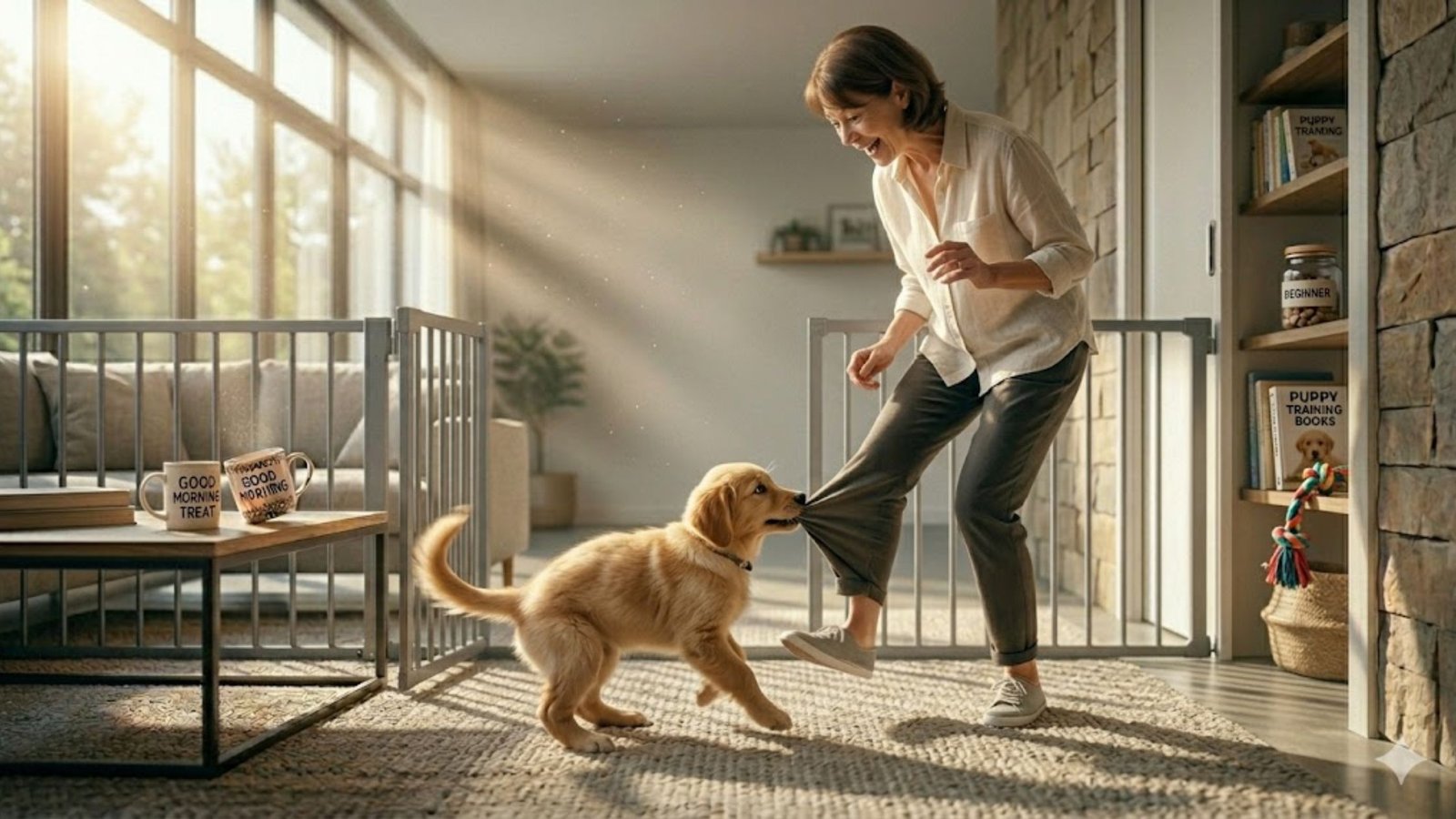
It looked ridiculous. My neighbors definitely judged me. But those thick rubber boots were the only thing standing between my ankles and a tiny set of razor-sharp puppy teeth every time I tried to walk from the kitchen to the living room.
You know exactly what I’m talking about, don’t you?
The moment you stand up from the couch—chomp. The second you try to walk to the bathroom—nip nip nip. You’re just trying to make coffee, and suddenly there’s a little land shark attached to your sock, growling like they’ve just brought down a wild beast.
It’s frustrating. It’s annoying. And honestly? It kind of hurts.
But here’s what I want you to know: Your puppy isn’t being aggressive. They aren’t trying to dominate you. And they’re definitely not broken.
Puppy biting feet when walking is one of the most common complaints I hear from new owners. And after raising Finn (and working with hundreds of clients over 8+ years), I’ve learned that the way most people try to stop it actually makes it worse.
I’m going to show you a better way. Three simple tips that stopped Finn from attacking my ankles in less than a week. No rain boots required.
Why Puppies Bite Feet (It’s Not What You Think)
Before we get to the solutions, you need to understand why your puppy is doing this. Because once you understand the why, the how becomes so much easier.
The Herding Breed Instinct
If you have a herding breed—Australian Shepherd, Corgi, Border Collie, German Shepherd—this is in their DNA. These dogs were literally bred to chase and nip at the heels of moving livestock. Your feet moving across the floor? That looks exactly like a sheep trying to escape the herd.
Finn is a Golden Retriever (retrievers, not herders), so I couldn’t blame instinct. Which meant I had to look deeper.
The Movement Trigger
Here’s the simple truth: Moving feet are exciting. To a puppy, your feet are unpredictable, fast-moving toys that squeak (your shoes) and make interesting sounds (pant legs swishing). When you walk, you’re essentially dragging the most interesting toy in the house right past your puppy’s face.
Would you expect a toddler to ignore a spinning, beeping, moving toy? Of course not. Same logic applies here.
The Attention-Seeking Loop
This is the part most owners get wrong.
When your puppy bites your feet, what do you do? You yelp. You look down. You say “no!” You might even push them away or try to pick them up.
Guess what? That’s all attention. And for a puppy who wants your focus, even negative attention is better than no attention.
Your puppy learns: “When I bite moving feet, the human stops walking and interacts with me. This is a great game!”
Teething and Overstimulation
Let’s not forget the physical reasons. Puppies teethe just like human babies. Their gums hurt. Biting and chewing relieve that pain. Your moving feet are just convenient chew toys.
Also, puppies have terrible impulse control. When they get overstimulated (usually during “witching hour” in the evening), they lose their tiny minds and bite anything that moves. Feet are usually closest.
The bottom line: Your puppy isn’t evil. They’re just being a puppy. And with a few small changes, you can teach them that feet are boring and toys are fun.
What NOT to Do (Please Read This First)
I tried all the “advice” I found online before I knew better. None of it worked. Some of it made Finn more anxious and bitey.
Don’t Yell or Scream
A high-pitched “OW!” might work for some puppies. For others? It sounds like a squeaky toy. You’re literally inviting them to bite harder.
Finn thought my yelps were hilarious. He would bite again just to hear the funny noise.
Don’t Push Your Puppy Away
When you push a puppy, they push back. It’s a reflex. Your “gentle push” feels like play wrestling to them. They will bite your hands instead of your feet. Congratulations, you’ve upgraded the problem.
Don’t Use Physical Punishment
No alpha rolls. No nose taps. No kneeing them in the chest. These methods don’t teach your puppy what to do—they just teach fear. A fearful puppy is more likely to bite, not less.
Don’t Freeze and Stand Still
I see this advice everywhere: “Stand still like a tree and ignore the biting.”
Here’s why that fails: Your puppy is now attached to your pants. Standing still doesn’t remove the biting. It just gives them more time to shred your hem. Plus, the moment you move again, the biting resumes because you’ve taught them that biting makes you stop moving (which is exactly what they want).
Don’t Run Away
Running triggers their chase instinct even more. Now you’re not just walking feet—you’re prey. Game on.
Tip #1: The Redirection Game (Teach What to Bite Instead)
This is the most important tip. You cannot simply stop a behavior without giving your puppy a replacement behavior. That’s like taking away a toddler’s pacifier and saying “just don’t suck on anything.” It doesn’t work.
The goal: Teach your puppy that toys are for biting, feet are not.
How to Do It (Step-by-Step)
Step 1: Before you even stand up, grab a high-value toy. Not a boring rope toy they ignore. Something squeaky, crinkly, or fluffy. I used a sheepskin toy that made a crackling sound.
Step 2: Stand up. The moment your puppy looks at your feet (before they bite), shove the toy in their mouth.
Step 3: Walk two steps. If they’re still holding the toy, praise them enthusiastically. “Good boy! Yes! You’re so smart!”
Step 4: If they drop the toy and go for your feet, freeze. Don’t move your feet. Say “uh-oh” in a neutral voice. Wait for them to look up at you (even for a split second), then immediately redirect to the toy again.
Step 5: Walk a little further. Repeat. Every time they choose the toy over your feet, it’s a party.
The “Toy on a String” Hack
Here’s what worked like magic for Finn: I tied a soft rope toy to a long piece of paracord. When I walked, I dragged the toy behind me like a tail. Finn was obsessed with chasing the toy instead of my ankles.
Within two days, he was ignoring my feet entirely and diving for the rope toy every time I stood up.
Why this works: You’re not fighting the chase instinct—you’re channeling it. Your puppy wants to chase moving things. Give them an appropriate moving thing to chase.
What If Your Puppy Ignores Toys?
Some puppies don’t care about toys. They want flesh. I get it. Finn was like this for the first week.
Try these alternative redirects:
- A frozen washcloth (the cold soothes teething gums)
- A bully stick or no-hide chew (hold it so they chew the end, not your fingers)
- A cardboard box to shred (messy but effective)
- A handful of kibble scattered on the floor (eating interrupts biting)
The key is finding something more interesting than your feet. Get creative.
Tip #2: The “Be a Boring Tree” Technique (Done Right)
I told you not to freeze like a tree earlier. But there is a correct way to use stillness—you just have to add one crucial element: removing the reinforcement.
How to Do It (The Right Way)
Step 1: The moment your puppy bites your feet, stop walking. Do not move your feet. Do not look at them. Do not speak.
Step 2: Cross your arms over your chest. Turn your face away from them. You are now the most boring tree in the forest.
Step 3: Count to 5 in your head. If your puppy stops biting and looks away or backs up, immediately mark it (“yes!”) and redirect to a toy.
Step 4: If your puppy continues biting after 5 seconds, calmly step behind a baby gate or into another room. Close the door. Stay out of sight for 10 seconds.
Step 5: Come back. Try again. If they bite again, repeat the 10-second separation.
Why This Works (The Science)
Puppies bite feet because it’s fun and gets a reaction. When you become a boring tree, you remove the fun. When you remove yourself entirely (behind a gate), you remove the reinforcement—which is you.
Your puppy learns: “When I bite moving feet, the human disappears. That’s boring. When I don’t bite, the human stays and plays. That’s fun.”
Important: The separation should be short (10-30 seconds) and calm. You’re not punishing. You’re just removing the audience. This is called “negative punishment” in behavior science (removing something good to decrease a behavior).
Finn’s “Aha Moment”
The first time I tried this, Finn was 10 weeks old. He bit my ankle. I stepped behind the baby gate. He sat there looking confused for 10 seconds. I came back. He bit again. I left again.
On the third try, he didn’t bite. He looked at my feet, looked at me, and then sat down. I nearly cried with joy. I threw a treat party. He never bit my feet again after that day.
I’m not saying it will work that fast for every puppy. But for most? It’s shockingly effective.
Tip #3: Management and Environment Setup (Stop Practicing the Behavior)
Here’s a concept that changed my entire approach to puppy training: Every time your puppy bites feet, they get better at biting feet.
Practice doesn’t make perfect. Practice makes permanent.
So your job isn’t just to train the right behavior—it’s to prevent the wrong behavior from being practiced in the first place.
Use Baby Gates to Create “No-Bite Zones”
Put baby gates in doorways. When you need to walk from the kitchen to the living room, close the gate behind you. Your puppy watches you from a distance, safely unable to reach your feet.
Why this works: Your puppy learns that feet move. That’s normal. But they also learn that they can’t always access those feet. Over time, the novelty of moving feet wears off.
Tether Your Puppy
Attach your puppy’s leash to a heavy piece of furniture or a doorknob. Give them a toy or chew. Now you can walk around the room safely—your puppy can see your feet moving but can’t reach them.
How long to tether: 5-10 minutes at a time, always supervised. This isn’t confinement. It’s a training tool.
Use an Ex-Pen (Exercise Pen)
Set up an exercise pen in your main living area. Your puppy stays inside the pen with toys and a bed. You walk freely outside the pen. Your puppy watches your feet move without being able to bite them.
The magic moment: After 5-10 minutes of watching boring feet that they can’t reach, most puppies lose interest entirely. Then when you let them out, they’re less likely to attack.
Wear “Boring” Footwear
I’m serious. Flip-flops? Those toes are bite targets. Fuzzy slippers? Those look like toys. Loose pant legs? Irresistible.
What to wear during training:
- Close-toed shoes (sneakers or boots)
- Tights or leggings (no flapping fabric)
- Jeans (thick denim is less fun to chew)
You won’t wear rain boots forever. Just for a week or two while you teach the new behavior.
Exhaust the Biting Before You Need to Walk
Puppies bite feet most when they have pent-up energy. Before you need to move around the house (making dinner, cleaning, etc.), wear your puppy out.
A 10-minute pre-walk routine:
- Tug-of-war (3 minutes)
- Fetch down a hallway (3 minutes)
- Scatter feeding (hide kibble in a towel, 4 minutes)
A tired puppy is a less bitey puppy. It’s not a guarantee, but it helps enormously.
The “Witching Hour” Survival Guide
Almost every puppy has a crazy time in the evening—usually between 6 PM and 9 PM. They zoom around, bite everything, and lose all self-control. Feet are their favorite target.
This is normal. It’s called “zoomies” or “FRAPs” (Frenetic Random Activity Periods). Your puppy isn’t broken. They’re just overtired, like a toddler who missed their nap.
How to Survive Witching Hour
Option 1: Enforced Naps
Most puppies need 18-20 hours of sleep per day. If your puppy is a bitey monster in the evening, they’re probably overtired. Put them in their crate with a frozen Kong. They’ll protest for 2 minutes, then pass out.
Option 2: The Frozen Washcloth
Wet a washcloth, twist it into a rope shape, and freeze it. When your puppy attacks their feet, shove the frozen washcloth in their mouth. The cold numbs their gums, and the texture satisfies the biting urge.
Option 3: The “Walk Away” Game
Have a second person hold a baby gate. When your puppy bites, the gate person opens the gate. You walk through and close it behind you. The puppy is on the other side. Wait 10 seconds. Come back. Repeat.
This is the same as Tip #2, just with a helper.
Option 4: Acceptance
Sometimes, you just need to put your puppy in their pen with a chew and walk away. It’s not punishment. It’s a boundary. You are allowed to have 20 minutes where you don’t get bitten.
The 5-Day Training Plan
Here’s exactly what I’d do if I were starting over with a foot-biting puppy today.
Day 1-2: Setup and Prevention
- Buy baby gates and an ex-pen.
- Wear boring shoes.
- Tether or pen your puppy when you need to walk around.
- Practice “be a boring tree” (Tip #2) 10 times.
Day 3-4: Redirection Focus
- Before standing up, grab a toy (Tip #1).
- Walk in 10-foot circles, rewarding every time the puppy takes the toy.
- Use the “toy on a string” hack.
- Enforce 2-3 crate naps during the witching hour.
Day 5+: Fading the Tools
- Start walking without the toy in your hand (keep one nearby).
- If the puppy bites, say “uh-oh” and redirect once.
- If they bite again, use the 10-second separation (behind the gate).
- Gradually increase how much you walk before rewarding.
By day 7, most puppies improve by 80-90%. The remaining 10% is management—keeping shoes put away, using gates when guests visit, and never leaving loose socks on the floor.
Common Questions
Is puppy biting feet a sign of aggression?
No. Almost never. True aggression in puppies under 6 months is extremely rare. Foot biting is almost always play, teething, herding instinct, or overstimulation. Aggressive puppies growl, stiffen, and bite to cause harm. Foot-biters are usually wagging their tails and have loose, wiggly bodies.
My puppy only bites my feet, not my partner’s. Why?
You’re probably more fun. Puppies bite the person who reacts the most. If you yelp, jump, or wave your arms, you’re a better playmate than your calm partner. Solution: Have your partner practice the “boring tree” technique while you leave the room. The puppy will learn that biting you = you leave.
What if my puppy bites and draws blood?
Puppy teeth are sharp. Even play biting can break skin. Clean the wound with soap and water. Apply antibiotic ointment. It’s not a sign that your puppy is dangerous—it’s a sign that their teeth are like needles. Focus on redirection and management.
When should I worry about puppy biting?
If your puppy is over 6 months old and still biting feet hard enough to bruise or bleed, consult a trainer. If your puppy growls, stiffens, and shows the whites of their eyes (whale eye) before biting, that’s fear or aggression—get help immediately.
Will my puppy grow out of foot biting?
Eventually, yes. Most puppies naturally stop foot biting by 5-6 months as they mature and finish teething. But do you really want to wait that long? Training now makes everyone happier.
Final Thoughts: You’re Doing Better Than You Think
I remember sitting on my kitchen floor at 11 PM, crying, while Finn gnawed on my rain boot. I had been a dog trainer for years. I had written articles about puppy biting. And yet here I was, defeated by a 12-pound furball.
Puppyhood is hard. It’s exhausting. And foot biting feels personal in a way that other puppy behaviors don’t. Like, why are you attacking me? I feed you. I love you. I picked up your poop this morning.
But here’s what I’ve learned from hundreds of puppy owners: The fact that you’re reading this, looking for solutions, trying to do better—that already makes you a great dog parent.
Your puppy isn’t giving you a hard time. They’re having a hard time. Their gums hurt. Their brains are developing. They don’t speak human. They’re just trying to figure out this weird world, and your moving feet are the most interesting thing in it.
Be patient with them. Be patient with yourself. Put on those rain boots if you need to. And know that this phase—annoying as it is—will pass.
Finn is two years old now. He hasn’t bitten a foot since he was 11 weeks old. He’s lying next to me as I type this, snoring softly, one paw draped over my sneaker.
Sometimes I miss the crazy puppy who attacked my ankles. Okay, no, I don’t. But I’m glad we figured it out together.
You will too.