
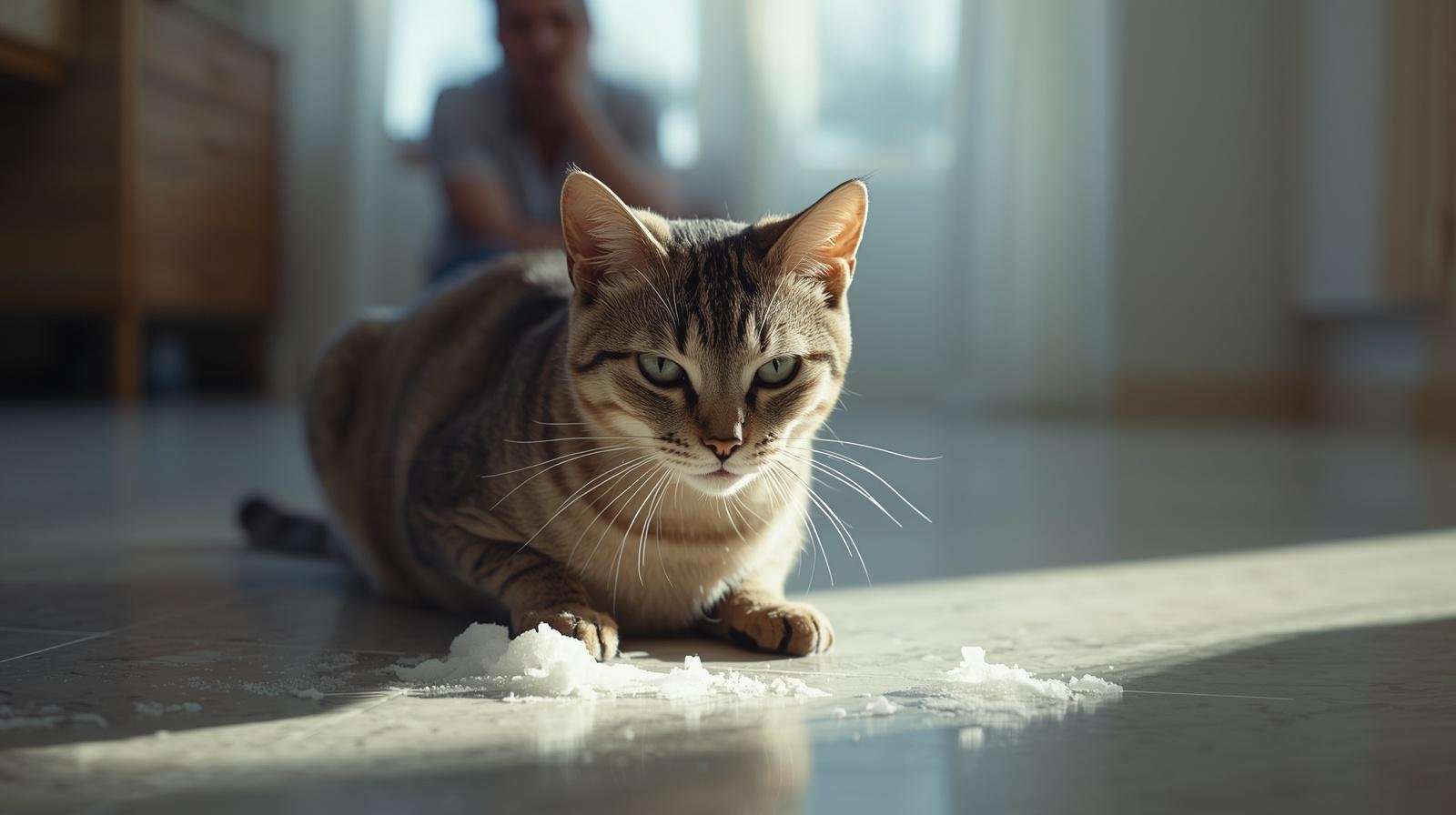
The first time Luna threw up white foam, I thought she was dying.
It was 6 AM. I was half-asleep, stumbling to the kitchen to make coffee. And then I heard it. That unmistakable sound. The hacking. The heaving. The “I’m about to ruin your morning” cough that every cat owner knows.
But when I got to her, nothing came out. Just white foam. Frothy, bubbly, soap-looking foam. No hairball. No food. No bile. Just… foam.
Luna looked at me like “well, that was weird.” Then she walked over to her food bowl and started eating breakfast like nothing had happened.
I, on the other hand, spent the next hour Googling “cat throwing up white foam” while holding her like she was made of glass.
Here’s what I learned that morning, after talking to my vet and calming myself down: White foam vomit is rarely an emergency by itself. But it’s almost always a sign that something is off. And depending on what else is happening, it can range from “nothing to worry about” to “get to the vet now.”
If your cat just threw up white foam and you’re sitting where I was—panicked, confused, and covered in coffee—take a breath. I’m going to walk you through everything I’ve learned over the years. Because Luna is fine. And your cat probably will be too. But you need to know the difference.
First, What IS White Foam Vomit?
Let’s start with the basics.
White foam vomit is not food. It’s not bile. It’s not a hairball.
It’s mostly saliva and gastric juices that have been whipped into a froth by the force of vomiting or retching.
Here’s what’s happening: Your cat’s stomach is empty (or nearly empty). Their body is trying to vomit, but there’s nothing solid to bring up. So all that comes out is stomach fluid, mucus, and saliva—aerated into foam by the heaving.
Think of it like this: When you have an empty stomach and you feel nauseous, you might dry heave. Same thing. The foam is just the “dry heave” version of cat vomit.
What white foam is NOT:
- It’s not a hairball (hairballs are tubular and contain… hair)
- It’s not bile (bile is yellow or green)
- It’s not blood (blood is red, pink, or coffee-ground brown)
- It’s not food (food vomit contains undigested kibble)
So if your cat is throwing up white foam, their stomach is empty. The question is: Why is their stomach empty, and why are they vomiting?
The 7 Most Common Causes (From “Nothing” to “Emergency”)
Let me walk you through the causes, starting with the most common and least scary.
Cause 1: Empty Stomach / Bilious Vomiting Syndrome
This is the most common cause of white foam vomit. And it’s usually nothing to worry about.
What’s happening: Your cat’s stomach has been empty for too long (usually overnight or while you’re at work). Bile backs up from the small intestine into the stomach, irritating the stomach lining. The irritation triggers vomiting, but since the stomach is empty, only foam comes up.
What it looks like:
- Vomiting occurs in the morning (before breakfast) or late at night
- Your cat vomits once or twice, then acts completely normal
- They eat breakfast right afterward (or want to)
- No other symptoms (diarrhea, lethargy, hiding)
Real story: Luna’s white foam vomit happened at 6 AM, right before breakfast. She threw up once, then ran to her food bowl. My vet said: “Feed her a small snack right before bed. Problem solved.” I started giving her a few kibbles at 10 PM. She hasn’t thrown up morning foam since.
What to do:
- Feed a small bedtime snack (a few kibbles, a tablespoon of canned food)
- Use a timed feeder for overnight or workday meals
- If it keeps happening, ask your vet about antacids (omeprazole, famotidine)
Urgency: None. This is a management issue, not a medical emergency.
Cause 2: Hairballs (The Misdirection)
This one surprises people. Hairballs don’t usually look like white foam. But sometimes they do.
What’s happening: Your cat has a hairball that’s stuck in the stomach or esophagus. They’re trying to bring it up, but it’s not moving. All that comes out is foam from the effort of retching.
What it looks like:
- Your cat is retching or hacking (not just vomiting)
- The foam may be followed by a hairball after several attempts
- Your cat may cough or gag in between episodes
- More common in long-haired cats (Persians, Maine Coons, Ragdolls) and during shedding season
What to do:
- Hairball remedy gel (Laxatone, Petromalt) – follow package instructions
- Add fiber to diet (canned pumpkin, 1 teaspoon daily)
- Brush your cat more frequently (daily during shedding season)
- Hairball-control cat food (Hill’s Science Diet, Royal Canin)
When to worry: If your cat is retching constantly without producing a hairball, or if they stop eating, see a vet. A hairball can cause a blockage in rare cases.
Urgency: Low to medium. Try hairball remedies for a few days. If no improvement, see a vet.
Cause 3: Dietary Indiscretion (Ate Something They Shouldn’t Have)
Cats are curious. Sometimes that curiosity leads to eating things that are not food.
What’s happening: Your cat ate something that irritated their stomach—a houseplant, a piece of string, a bug, spoiled food from the trash. The stomach tries to expel the irritant. If the stomach is otherwise empty, you get foam.
What it looks like:
- Sudden onset of vomiting (one or two episodes)
- Your cat may vomit foam first, then food, then foam again
- May have diarrhea as the irritant moves through the system
- Your cat may hide or act uncomfortable
- You may find evidence of what they ate (chewed plant, torn trash bag)
What to do:
- Remove the irritant (hide plants, secure trash, put away string)
- Withhold food for 6-12 hours (to let the stomach settle)
- Offer small amounts of water (ice cubes are good—they lick them slowly)
- After 12 hours with no vomiting, offer a small amount of bland food (boiled chicken and rice)
When to worry: If your cat vomits more than 3 times in 24 hours, if there’s blood in the vomit, if they stop eating for more than 24 hours, or if you know they ate something toxic (lilies, onions, garlic, xylitol, string).
Urgency: Low to medium. Monitor closely. Call your vet if symptoms persist.
Cause 4: Indigestion or Mild Gastritis
Sometimes cats just have an upset stomach. Just like humans.
What’s happening: The stomach lining is irritated—maybe from a new food, a stressful event, or a mild viral infection. The irritation causes nausea and vomiting. If the stomach is empty, you get foam.
What it looks like:
- One or two episodes of vomiting
- Your cat may seem slightly lethargic or “off”
- No diarrhea (or mild diarrhea)
- Normal appetite (or slightly reduced)
- Resolves within 24 hours
What to do:
- Withhold food for 6-12 hours
- Offer small amounts of water
- After 12 hours, offer a bland diet (boiled chicken and rice)
- Gradually transition back to normal food over 2-3 days
When to worry: If vomiting continues for more than 24 hours, if your cat stops eating, or if they develop diarrhea.
Urgency: Low. Most mild gastritis resolves on its own.
Cause 5: Inflammatory Bowel Disease (IBD)
This is a chronic condition, not an emergency. But it’s a common cause of recurring white foam vomit.
What’s happening: Your cat’s immune system is overreacting to something in their food (usually a protein like chicken, beef, or fish). The chronic inflammation causes intermittent vomiting, often of white foam or bile.
What it looks like:
- Chronic, recurring vomiting (weekly or monthly)
- Often vomits white foam or yellow bile (not food)
- May have chronic diarrhea or soft stool
- Weight loss despite normal appetite
- Cat may be a senior (but can occur at any age)
What to do: See a vet. IBD is diagnosed through blood work, ultrasound, and sometimes intestinal biopsy. Treatment usually involves a prescription diet (hydrolyzed protein or novel protein) and sometimes steroids.
Real story: A client’s Siamese cat, Kona, had been throwing up white foam for two years. Every vet said “hairballs.” Finally, an ultrasound showed thickened intestines. Kona had IBD. She was switched to a rabbit-based prescription diet. The vomiting stopped within a week.
Urgency: Low (if cat is acting normal otherwise). But schedule a vet visit within a few weeks.
Cause 6: Pancreatitis
This is more serious. Pancreatitis is inflammation of the pancreas, and it can be very painful.
What’s happening: The pancreas becomes inflamed, often due to a high-fat meal, trauma, or unknown causes. The inflammation causes severe nausea, abdominal pain, and vomiting.
What it looks like:
- Repeated vomiting (white foam, then yellow bile, then nothing)
- Lethargy (cat is hiding, not moving much)
- Loss of appetite (refuses food, even treats)
- Painful belly (may cry when picked up or resist being touched)
- May have a fever
Which cats are at risk: Any cat, but it’s more common in middle-aged and senior cats. Certain breeds (Siamese, Oriental) may be predisposed.
Diagnosis: Blood test (feline pancreatic lipase), ultrasound.
Treatment: Hospitalization, IV fluids, pain medication, anti-nausea medication, and a low-fat diet.
Urgency: HIGH. If your cat is vomiting repeatedly AND acting lethargic or not eating, see a vet within 24 hours (sooner if possible).
Cause 7: Kidney Disease or Hyperthyroidism (The Senior Cat Issues)
These are common in older cats. Both can cause chronic vomiting, including white foam.
What’s happening:
- Kidney disease: Toxins build up in the blood (uremia), causing nausea and vomiting. The vomit is often white foam or bile, especially in the morning.
- Hyperthyroidism: The thyroid gland produces too much hormone, speeding up metabolism. The cat eats constantly but vomits frequently.
What it looks like:
- Senior cat (over 10 years old)
- Chronic, intermittent vomiting (often white foam or bile)
- Increased thirst and urination (kidney disease)
- Ravenous appetite but weight loss (hyperthyroidism)
- Poor coat condition (unkempt, matted fur)
- Lethargy or hiding
What to do: See a vet for blood work (senior wellness panel). Both conditions are manageable but not curable.
Real story: My friend’s 14-year-old cat, Mochi, started throwing up white foam every few days. The owner thought it was hairballs. Blood work showed early kidney disease. With a prescription kidney diet and subcutaneous fluids at home, Mochi lived another two years with minimal vomiting.
Urgency: Medium (if cat is acting otherwise normal). Schedule a vet visit within 1-2 weeks. If cat is lethargic, not eating, or hiding, see a vet immediately.
The “When to Worry” Decision Guide
This is the most important part of this article. Use this chart to decide what to do.
| Symptoms | Likely Cause | Urgency |
| One episode of white foam, cat acts normal, wants to eat | Empty stomach | None – monitor |
| White foam + retching + long-haired cat | Hairball | Low – try hairball remedy |
| White foam + no appetite + lethargy + hiding | Pancreatitis or other serious illness | HIGH – vet within 24 hours |
| White foam + diarrhea + no appetite | Gastroenteritis or infection | Medium – vet within 24-48 hours |
| White foam + increased thirst + senior cat | Kidney disease | Medium – vet within 1 week |
| White foam + ravenous appetite + weight loss + senior cat | Hyperthyroidism | Medium – vet within 1 week |
| White foam + blood (red or coffee-ground) | Ulcer, toxin, or serious inflammation | EMERGENCY – vet NOW |
| White foam + bloated belly + unproductive retching | Possible blockage or GDV (rare in cats) | EMERGENCY – vet NOW |
| White foam + known ingestion of toxin (lily, antifreeze, etc.) | Poisoning | EMERGENCY – vet NOW |
Immediate Care: What to Do Right Now
Your cat just threw up white foam. You’re standing there with a paper towel and a worried heart. Here’s your action plan.
Step 1: Assess the Situation (30 seconds)
- How many times has your cat vomited? (Once? Three times? Ten times?)
- Is there blood? (Red, pink, or brown coffee-ground color?)
- Is your cat acting normal? (Eating? Playing? Alert? Hiding?)
- Do you know of any toxin exposure? (Lilies in the house? Antifreeze in the garage? Human medication dropped on the floor?)
Step 2: If Emergency Signs Are Present – GO TO VET
Emergency signs:
- Vomiting blood
- Bloated or painful belly
- Unproductive retching (heaving but nothing comes out)
- Known toxin ingestion
- Cat is collapsed or unresponsive
- Gums are pale, blue, or yellow
Do not wait. Do not pass go. Go to the emergency vet.
Step 3: If No Emergency Signs – Monitor at Home
What to do for the next 6 hours:
| Time | Action |
| First hour | Withhold food. Offer small amounts of water (1-2 tablespoons every hour). Ice cubes are great—cats lick them slowly. |
| 2-3 hours | If no further vomiting, continue offering small amounts of water. |
| 4-6 hours | If still no vomiting, offer a very small amount of bland food (1 tablespoon of boiled chicken and rice). |
| 6+ hours | If cat keeps down the bland food, offer another small portion. Gradually increase over 24 hours. |
If your cat vomits again during this time: Stop food and water. Wait another 2 hours. Try water again. If vomiting continues, call your vet.
Step 4: When to Call the Vet (Non-Emergency)
Call your vet if:
- Vomiting continues for more than 24 hours.
- Your cat refuses food for more than 24 hours.
- Your cat develops diarrhea.
- Your cat seems lethargic or is hiding.
- The white foam vomit keeps happening (daily or weekly).
What NOT to Do (Please Read This)
I’ve seen well-meaning cat owners make these mistakes. Don’t be one of them.
Don’t give human medication. No Pepto-Bismol, no Imodium, no antacids without vet approval. Many human medications are toxic to cats.
Don’t force water. If your cat is nauseous, forcing water can make them vomit more. Offer water. Don’t force it.
Don’t wait indefinitely. If your cat hasn’t eaten in 24 hours, that’s an emergency. Cats can get hepatic lipidosis (fatty liver disease) from not eating for just a few days.
Don’t assume it’s just a hairball. Hairballs don’t cause lethargy, loss of appetite, or hiding. If your cat is acting sick, it’s not just a hairball.
Don’t panic. Most white foam vomiting is not an emergency. Panic won’t help your cat. Breathe. Assess. Act accordingly.
When It’s Not Vomiting (Could Be Regurgitation)
Here’s something many cat owners don’t know: There’s a difference between vomiting and regurgitation.
| Feature | Vomiting | Regurgitation |
| Effort | Active heaving, retching | Passive, no effort |
| Warning | Cat may drool, lick lips, hide | Happens suddenly, often right after eating |
| Content | Partially digested food, foam, bile | Undigested food, often tube-shaped |
| Timing | Hours after eating | Minutes after eating |
| Cause | Stomach issue (infection, IBD, pancreatitis) | Esophagus issue (megaesophagus, stricture) |
Regurgitation of white foam is less common, but it can happen if your cat has a condition called megaesophagus (enlarged esophagus that doesn’t move food down properly).
If your cat “vomits” white foam without any heaving or effort—it just falls out of their mouth—that’s regurgitation. See a vet. Megaesophagus is manageable but requires special feeding (elevated bowls, upright feeding).
Prevention: How to Reduce White Foam Vomiting
Once you know why your cat is vomiting, you can prevent it.
For empty stomach vomiting:
- Feed smaller, more frequent meals (3-4 times per day)
- Use an automatic feeder for overnight or workday meals
- Give a bedtime snack
For hairballs:
- Brush daily (especially during shedding season)
- Hairball remedy gel (weekly or as directed)
- Hairball-control cat food
- Add fiber (canned pumpkin, 1 teaspoon daily)
For dietary indiscretion:
- Cat-proof your home (secure trash, toxic plants out of reach)
- No string, ribbon, or tinsel (these cause blockages)
- No people food without checking safety first
For chronic conditions (IBD, kidney disease, hyperthyroidism):
- Follow your vet’s treatment plan
- Prescription diet (if recommended)
- Regular blood work to monitor
The “Just in Case” Vet Visit
Here’s my rule of thumb: If your cat has thrown up white foam more than twice in a month, see a vet.
Not because it’s an emergency. Because chronic vomiting is not normal. Even if your cat acts fine between episodes, something is causing it. And most causes are treatable.
A single episode of white foam? Probably nothing. Two episodes? Monitor. Three or more? Vet visit.
Luna has occasional white foam vomit if she goes too long without eating. I know that now. So I don’t panic. I just give her a snack and move on.
But if she started vomiting foam every week? I’d be at the vet.
You know your cat. You know what’s normal for them. Trust that.
FAQ
Why is my cat throwing up white foam but acting normal?
This is almost always an empty stomach (bilious vomiting syndrome). Your cat’s stomach has been empty for too long, and bile is irritating the stomach lining. Try a bedtime snack. If it keeps happening, see a vet to rule out other causes.
Is white foam always a hairball?
No. Hairballs usually contain hair and are tubular in shape. White foam alone (without hair) is not a hairball. However, your cat may be trying to bring up a hairball that isn’t moving, so all that comes out is foam.
Should I feed my cat after they throw up white foam?
Wait 6-12 hours. Let the stomach settle. Then offer a small amount of bland food (boiled chicken and rice). If they keep that down, gradually return to normal food. If they vomit again, stop food and call your vet.
Can stress cause a cat to throw up white foam?
Yes. Stress can cause nausea and vomiting in cats. Common stressors: moving, new pet, new baby, construction, boarding, vet visits. The vomit is often white foam if the stomach is empty. Treat the stress (Feliway diffusers, safe spaces, routine) and the vomiting may stop.
My cat is throwing up white foam and not eating. How long can they go without food?
Not long. Cats who don’t eat for 24-48 hours are at risk for hepatic lipidosis (fatty liver disease), which can be fatal. If your cat hasn’t eaten in 24 hours, see a vet. If they’re also lethargic or hiding, see a vet sooner.
What’s the difference between white foam and clear liquid vomit?
Clear liquid is usually just water and saliva. White foam has more air and mucus. Both indicate an empty stomach. The causes are the same.
Final Thoughts: Luna’s Lesson
Luna is curled up on my lap as I type this. She hasn’t thrown up white foam in months. The bedtime snack solved it.
But I’ll never forget that first morning—the panic, the Googling, the certainty that something was terribly wrong. I learned that day that most cat vomit is not an emergency. But I also learned that “most” is not “all.”
The difference is in the details. Is your cat acting normal? Are they eating? Are they playing? Or are they hiding, lethargic, refusing food?
You know your cat better than anyone. If something feels wrong, trust that feeling. Call your vet. That’s what they’re there for.
But if your cat just threw up a little white foam and is now demanding breakfast like nothing happened? Take a breath. Give them a snack. And maybe keep a paper towel handy.
You’ve got this.