
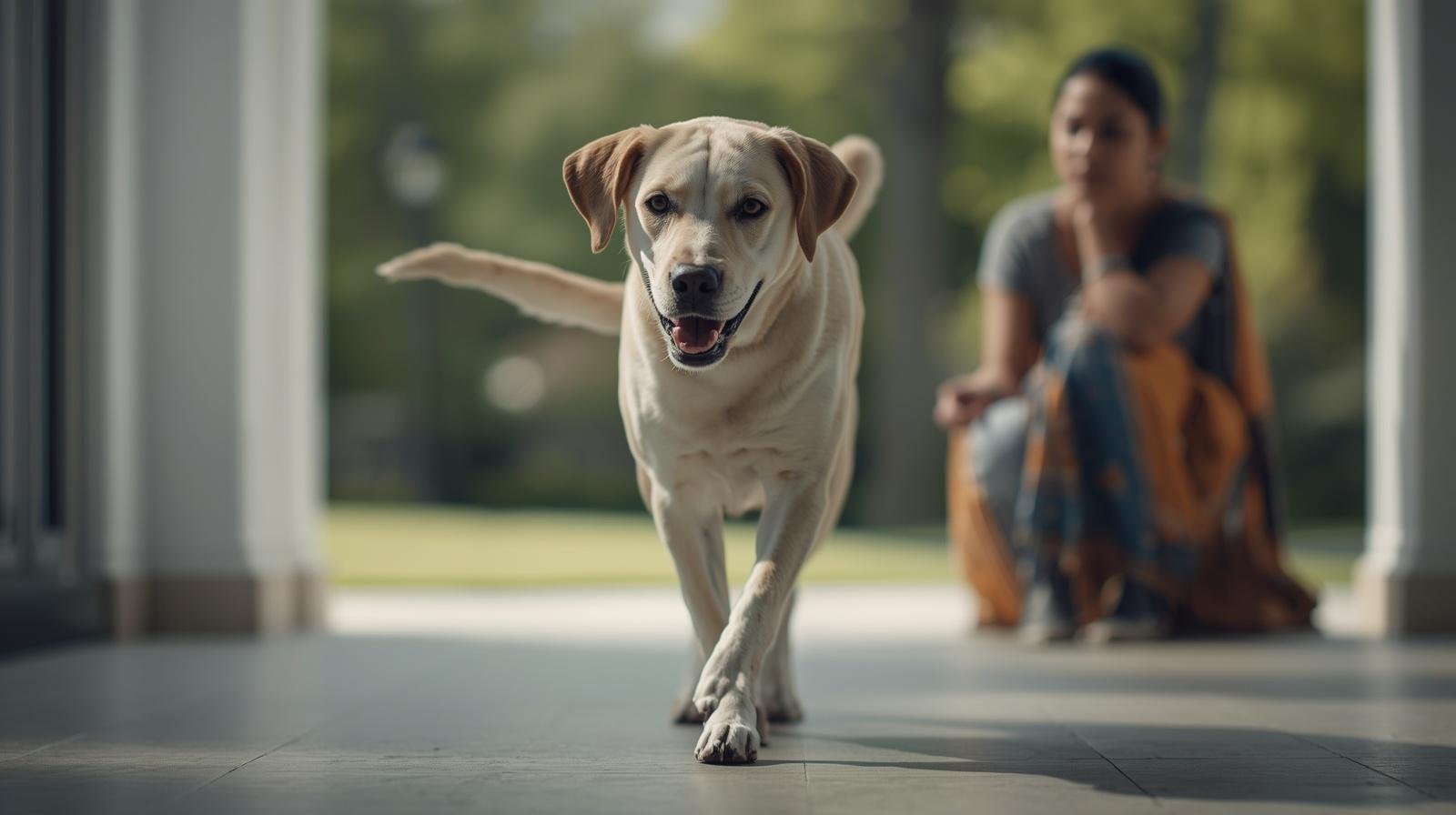
The first time I noticed Finn limping, my heart stopped.
We had just come back from our morning walk. He was trotting ahead of me, tail wagging, happy as always. And then I saw it. A slight hitch in his step. A tiny hesitation every time his front left paw hit the pavement.
I dropped to my knees immediately. I ran my hands down his leg. I squeezed his paw. I bent his elbow. I checked between his toes. Nothing. No yelp. No flinch. No pulling away. He just looked at me like “Mom, what are you doing? Can we go inside? I want breakfast.”
He ate his breakfast. He played with his toys. He rolled on his back for belly rubs. He was 100% normal except for that tiny limp.
I spent the next three days obsessively watching him. Is the limp worse today? Is it better? Did he just sleep funny? Is he hiding pain? Is this cancer? (My brain always goes to cancer.)
I called my vet. I sent videos. I drove myself crazy.
And here’s what I learned: A dog can limp without acting like they’re in pain. And most of the time, it’s not an emergency. But sometimes, it is. And the difference isn’t always obvious.
If you’re reading this, you’re probably in the same boat. Your dog is limping on their front leg, but they’re eating, playing, and acting completely normal. You’re not sure if you should rush to the emergency vet or wait and see.
Let me walk you through what I learned after years of working with dogs (and worrying about my own). Because Finn’s limp turned out to be nothing serious. But I’ve seen cases where “just a little limp” was something much bigger.
The Short Answer: When to Worry
If your dog is limping but acting completely normal otherwise (eating, playing, alert, not painful when you touch the leg), you can usually wait 24-48 hours and monitor.
BUT—and this is a big but—there are exceptions.
Go to the vet immediately if:
- The leg is swollen, hot, or visibly misshapen.
- Your dog won’t put any weight on the leg at all (carrying it).
- The limp started suddenly after a jump, fall, or known trauma.
- Your dog is also lethargic, not eating, or has a fever.
- The limp is getting worse, not better.
Schedule a vet visit within the week if:
- The limp has been going on for more than 3-5 days with no improvement.
- The limp is intermittent (comes and goes).
- Your dog is a large breed puppy (could be growing pains or a developmental issue).
- Your dog is a senior (over 8 years old).
- The limp shifts from leg to leg
You probably don’t need a vet if:
- The limp is very mild, and your dog is totally normal otherwise.
- The limp started after exercise and improved with rest.
- You can identify a minor cause (stepped on something, nail is too long, slept funny).
But let me be clear: Dogs are masters of hiding pain. Just because your dog isn’t yelping doesn’t mean they aren’t hurting. Limping IS a sign of pain. It’s just that some dogs have a high pain tolerance, and some injuries don’t cause constant pain.
So let me help you figure out what’s actually happening inside that front leg.
Why Dogs Hide Pain (It’s Not Being Brave)
Before we get into the causes, you need to understand something important.
In the wild, a dog who shows weakness gets eaten. That’s not metaphor—that’s evolution. Wolves and wild dogs who limp or cry out are targeted by predators. So dogs have evolved to hide pain as much as possible.
Your dog not yelping doesn’t mean they don’t hurt. It means they’re a dog.
A dog with a broken leg may still wag their tail when you come home. A dog with arthritis may still chase a squirrel (and then limp for three days afterward). A dog with a torn ligament may still eat their dinner with enthusiasm.
Limping IS the sign of pain. The severity of the limp tells you how much it hurts, but the absence of crying or whining tells you nothing.
So when I say “your dog is acting normal,” I mean:
- Eating and drinking normally
- Alert and responsive
- Playing (maybe a little less enthusiastically than usual)
- Not lethargic or hiding
But they’re still limping. That limp is real. And it has a cause.
The Front Leg Limp: What’s Different?
Front leg limps are different from back leg limps. The anatomy is different, and the causes are different.
Front leg weight-bearing: Dogs carry about 60% of their body weight on their front legs. That’s a lot of pressure. A small problem in a front leg can look like a big limp because every step puts force on the injury.
Common front leg issues:
- Paw problems (most common)
- Elbow problems (second most common)
- Shoulder problems (less common)
- Wrist (carpus) problems
Let me break down each one.
Cause 1: Paw Problems (The Most Common)
This is what I hope your dog has. Because paw problems are usually minor and easy to fix.
What’s happening: Something is irritating your dog’s paw. Every time they step, it hurts a little. But between steps, when there’s no pressure on the paw, it doesn’t hurt at all. That’s why your dog acts normal otherwise.
Common paw issues that cause limping but no yelping:
| Issue | What It Looks Like | What to Do |
| Broken or cracked nail | Nail is split, bent, or missing a piece. May be slightly red at the base. | Trim the sharp edge. Keep clean. See vet if bleeding or infected. |
| Torn pad | A flap of pad is loose. You might see a small gap or redness. | Clean with saline. Keep dog from licking. Vet if deep or not healing. |
| Foreign object (grass seed, thorn) | Tiny object embedded between toes or in pad. Dog may lick the paw. | Try to see it with a bright light. Remove with tweezers if easy. Vet if deep or you can’t find it. |
| Cut or abrasion | Small scrape on the pad or between toes. May not bleed much. | Clean with saline. Apply pet-safe antibiotic ointment. Monitor for infection. |
| Allergies (contact or atopic) | Paws are red, itchy, and sometimes swollen. Dog may lick them constantly. | Vet for diagnosis. May need allergy medication or diet change. |
The “at-home” test: Run your fingers between each toe. Gently squeeze each nail. Press on the pad. Look for redness, swelling, or discharge. If your dog flinches when you touch a specific spot, you’ve found the problem.
Real story: Finn’s limp was caused by a cracked nail. I didn’t see it at first because the crack was underneath, near the quick. The nail wasn’t broken off—just split. Every time he stepped, the two halves of the nail spread apart, pinching the quick. My vet trimmed the nail back and filed it smooth. The limp was gone the next day.
Cause 2: Soft Tissue Injury (Sprain or Strain)
This is the second most common cause of “limping but acting normal.”
What’s happening: Your dog stretched or partially tore a ligament, tendon, or muscle in their front leg. It hurts to put weight on it, but it’s not a break or a full tear. Rest will usually heal it.
How it happens:
- Running too hard (especially on uneven ground)
- Slipping on a slippery floor
- Twisting while playing fetch
- Jumping off furniture
- Overdoing it at the dog park
What it looks like:
- Limp is worse after exercise and better after rest
- No swelling (or very mild swelling)
- No pain when you touch the leg (unless you press very hard on the injured spot)
- Dog may be slightly less enthusiastic about running or jumping
The “rest test”: Crate rest or confinement for 48 hours. If the limp improves significantly with rest, it’s likely a soft tissue injury. If the limp is the same or worse after rest, something else is going on.
Treatment:
- Rest (no running, jumping, or stairs for 5-7 days)
- Short leash walks only (for potty breaks)
- Anti-inflammatories (only if prescribed by a vet—never give human ibuprofen or aspirin)
- Ice pack (10 minutes, twice daily, for the first 48 hours)
- Warm compress (after 48 hours, to increase blood flow)
When to see a vet: If the limp hasn’t improved after 3-5 days of rest, or if it keeps recurring every time your dog exercises.
Cause 3: Elbow Dysplasia or Arthritis (The Senior Dog Issue)
This is common in medium and large breed dogs, especially as they age.
What’s happening: The elbow joint doesn’t form properly (dysplasia) or has worn down over time (arthritis). The joint is stiff and painful, especially after rest. Once your dog “warms up,” the limp may seem to improve.
What it looks like:
- Limp is worse first thing in the morning or after naps
- Limp improves after a few minutes of walking (“warming up”)
- Dog may be stiff when getting up
- No yelping or obvious pain when you touch the leg
- Often affects both front legs (but one may be worse)
Which breeds are at risk:
- Labrador Retrievers
- Golden Retrievers
- German Shepherds
- Rottweilers
- Bernese Mountain Dogs
- Bulldogs
- Any large or giant breed
Diagnosis: X-rays. Your vet will look for narrowing of the joint space, bone spurs, or abnormal bone formation.
Treatment:
- Weight management (most important)
- Joint supplements (glucosamine, chondroitin, omega-3 fatty acids)
- Prescription anti-inflammatories (Carprofen, Galliprant)
- Physical therapy (underwater treadmill, range-of-motion exercises)
- Surgery (for severe dysplasia in young dogs)
Real story: A client’s 9-year-old Lab, Maggie, had a front leg limp that came and went. Some days she was fine. Other days she held her paw up. The owner thought it was just “old age.” X-rays showed severe elbow arthritis. Once Maggie started on daily anti-inflammatories and a joint supplement, her limp improved by 80%. She still limps after long hikes, but she’s comfortable day-to-day.
Cause 4: Osteochondritis Dissecans (OCD) in Puppies
This one sounds scary, but it’s treatable. And it only affects young dogs.
What’s happening: A flap of cartilage forms abnormally in the shoulder or elbow joint. The flap can detach and float around, causing pain and limping. It’s a developmental issue, not an injury.
Which dogs are at risk:
- Large and giant breed puppies (4-10 months old)
- Labs, Goldens, Rottweilers, Great Danes, Newfoundlands
- More common in males
What it looks like:
- Gradual onset of limping (not sudden)
- Limp gets worse with exercise
- Dog may hold the leg up when standing still
- No obvious injury or trauma
- Dog is otherwise healthy and growing normally
Diagnosis: X-rays (the flap of cartilage may be visible) or CT scan.
Treatment:
- Rest and activity restriction (for small flaps that may heal on their own)
- Surgery (arthroscopy to remove the loose flap) – most dogs recover fully within 2-4 months
Prognosis: Excellent with surgery. Most dogs return to full activity with no long-term issues.
Cause 5: Bone Cancer (Osteosarcoma) – The One You’re Worried About
I’m not going to sugarcoat this. This is the scary one. But it’s also rare, and it almost never happens in young dogs.
What’s happening: A tumor grows in the bone, weakening it. Over time, the bone becomes painful and may fracture spontaneously.
What it looks like:
- Limp that starts mild and gradually gets worse over weeks
- No improvement with rest (this is key—cancer limps don’t get better when the dog rests)
- Swelling at the site of the tumor (you may feel a firm lump on the leg)
- The leg may be warm to the touch
- Dog may be lethargic or lose appetite (in later stages)
Which dogs are at risk:
- Large and giant breeds (over 60 lbs)
- Senior dogs (over 7-8 years old, though it can occur in younger dogs)
- Greyhounds, Rottweilers, Great Danes, German Shepherds, Golden Retrievers
Diagnosis: X-rays (the tumor has a characteristic “moth-eaten” appearance). Biopsy for confirmation.
The “rest test” for cancer: If your dog’s limp improves with rest (like a soft tissue injury), it’s almost certainly NOT cancer. Cancer limps don’t get better when the dog rests. They get steadily worse over time.
Real story: A client’s 10-year-old Great Dane, Tank, had a front leg limp. The owner thought it was arthritis. Tank rested for a week. The limp didn’t improve. X-rays showed osteosarcoma. Tank’s leg was amputated (dogs do amazingly well on three legs), and he started chemotherapy. He lived another 14 months pain-free.
I’m not telling you this to scare you. I’m telling you because early detection matters. If your senior dog has a limp that doesn’t improve with rest, see a vet.
The 48-Hour Home Monitoring Protocol
If your dog is limping but acting normal, here’s exactly what to do for the next two days.
Day 1: Rest and Assess
Morning:
- Check the paw thoroughly (between toes, nails, pads)
- Feel the leg from shoulder to toe (any heat? swelling? lumps?)
- Compare to the other front leg (is one side different?)
All day:
- Crate rest or confinement to a small room (no running, jumping, stairs, or rough play)
- Leash walks only for potty breaks (5 minutes max)
- No dog park, no fetch, no wrestling with other dogs
Evening:
- Re-check the paw and leg
- Note: Is the limp better, worse, or the same?
Day 2: Reassess
If the limp is IMPROVED:
- Continue rest for 3-5 more days
- If the limp resolves completely, slowly return to normal activity
- If the limp returns when active, see a vet (likely a soft tissue injury that needs more rest or treatment)
If the limp is THE SAME:
- Continue rest for 2 more days
- If no improvement by Day 4, see a vet
If the limp is WORSE:
- Stop home monitoring
- See a vet within 24 hours
What to Do During Rest (So Your Dog Doesn’t Go Crazy)
A bored dog is a destructive dog. Here’s how to keep a rested dog sane.
- Frozen Kongs (peanut butter, yogurt, pumpkin)
- Snuffle mats (hide kibble in fabric)
- Gentle massage (if your dog likes it)
- Training (sit, down, touch—mental exercise is tiring)
- Chews (bully sticks, no-hide chews—supervised)
What NOT to do: No tug-of-war, no fetch, no running in the yard. Rest means rest.
The “Pain Face” Test: How to Tell If Your Dog Is Hurting
Your dog may not yelp, but they might show pain in other ways. Here’s what to look for.
| Reluctance to bear weight | Dog shifts weight to the other leg when standing still |
| Changes in posture | Head lower than normal, back hunched, leg held out |
| Facial expression | Furrowed brow, squinty eyes, ears back, lip licking |
| Panting | Panting when it’s not hot and they haven’t exercised |
| Restlessness | Can’t get comfortable, keeps changing position |
| Hiding | Dog goes under the bed or into a closet (sign of significant pain) |
| Changes in sleep | Sleeping more than usual or trouble falling asleep |
If you see any of these signs along with the limp, your dog is in more pain than they’re letting on. See a vet.
The Vet Visit: What to Expect
If you decide to take your dog to the vet for a front leg limp, here’s what will happen.
Step 1: History and Observation
The vet will watch your dog walk. They’ll ask when the limp started, if it’s getting better or worse, and if there was any known injury.
Step 2: Orthopedic Exam
The vet will feel your dog’s leg from shoulder to paw, flexing and extending each joint. They’ll look for:
- Pain response (a flinch, pulling away, or turning the head)
- Crepitus (a grinding sensation in the joint)
- Swelling or heat
- Range of motion
Step 3: Paw Exam
The vet will check between toes, look at nails, and examine the pads.
Step 4: X-rays (if needed)
If the vet suspects a bone issue, elbow dysplasia, arthritis, or cancer, they’ll recommend X-rays. Sedation is often needed because the dog has to hold still in specific positions.
Step 5: Treatment Plan
- Minor paw issue: Home care (cleaning, bandaging, nail trim)
- Soft tissue injury: Rest, anti-inflammatories, follow-up in 1-2 weeks
- Arthritis or dysplasia: Long-term management plan (medication, supplements, weight loss, physical therapy)
- OCD: Referral to surgeon
- Fracture or cancer: Emergency referral
Cost: Exam ($50-80) + X-rays ($150-300) + Medications ($20-50). Total: $200-450.
When Limping Is an Emergency (Do Not Wait)
I’ve said you can usually wait 24-48 hours. But not always.
Go to the emergency vet immediately if:
| Sign | What It Could Mean |
| Leg is dangling or obviously broken | Fracture |
| Swelling is severe and came on suddenly | Fracture, dislocated joint, or severe soft tissue tear |
| Paw or leg is cold to the touch | Blood flow problem (rare, but serious) |
| Paw or leg is dragging (not just limping) | Neurological issue (nerve damage) |
| Your dog won’t put ANY weight on the leg (carrying it) | Possible fracture or complete ligament tear |
| Your dog is also lethargic, not eating, vomiting, or has a fever | Systemic illness (Lyme disease, infection, or other illness causing joint pain) |
Real story: A client’s dog came in limping on a front leg. The owner thought it was a sprain. The dog wasn’t yelping. But the leg was slightly swollen, and the dog wouldn’t put any weight on it. X-rays showed a radial fracture. The dog had jumped off the couch and landed wrong. The fracture was stable (not displaced), so it healed with a splint. But if the owner had waited a week, the fracture could have displaced and required surgery.
Prevention: How to Reduce Front Leg Injuries
You can’t prevent everything. But you can reduce the risk.
At home:
- Put rugs on slippery floors (wood, tile, laminate)
- Use ramps or stairs for furniture (especially for senior dogs and small breeds)
- Keep nails trimmed (long nails change the angle of the paw and stress the wrist)
- Maintain a healthy weight (less weight = less stress on front legs)
During exercise:
- Warm up with slow walking before running
- Avoid jumping from heights (cars, retaining walls, high beds)
- Limit repetitive high-impact activities (fetch on hard surfaces, agility for dogs with poor structure)
- Provide soft surfaces for play (grass, not concrete)
For puppies:
- Don’t over-exercise large breed puppies (their growth plates close later)
- Avoid stairs until 6+ months (depending on breed)
- No jogging on leash until growth plates close (12-18 months for large breeds)
FAQ
Can a dog limp without being in pain?
No. Limping IS a sign of pain. The pain may be mild, intermittent, or well-hidden, but it’s there. Dogs don’t fake limp for attention. If your dog is limping, something hurts.
Why is my dog limping but fine when I touch the leg?
Dogs can have “referred pain” or deep pain that isn’t surface-sensitive. A torn ligament or arthritic joint may hurt when bearing weight but not when touched. Also, some dogs are stoic and won’t react to palpation even with significant injury.
My dog is limping after sleeping. Is that normal?
Yes, for senior dogs with arthritis. Limping that’s worse after rest and improves with movement is classic arthritis. For young dogs, limping after rest could be a soft tissue injury or growing pain. Monitor and see a vet if it continues.
How long should I wait before taking my dog to the vet for a limp?
For a mild limp with no other symptoms and no known trauma: 24-48 hours of rest. If no improvement, see a vet. For a moderate limp (dog is limping consistently but still using the leg): See a vet within 24 hours. For a severe limp (dog won’t put weight on the leg): See a vet immediately.
Can a dog’s limp heal on its own?
Yes, minor soft tissue injuries and minor paw issues often heal with rest alone. But if the limp hasn’t improved after 3-5 days of rest, or if it keeps coming back, see a vet. Some injuries (like a partial cruciate tear or OCD flap) won’t heal on their own and may worsen without treatment.
My dog is limping but still wants to play. Should I let them?
No. Dogs don’t understand that rest helps healing. If your dog is limping, they need rest—even if they’re acting enthusiastic. Limping while playing can turn a mild injury into a severe one. Crate rest or confinement is the kindest thing you can do.
Final Thoughts: Trust Your Gut, But Don’t Panic
Finn’s limp resolved with a nail trim and two days of rest. He was fine. I was not fine. I spent 72 hours convinced he had bone cancer, a torn ligament, or some exotic disease I’d never heard of.
I learned something from that experience: Most limps are not emergencies. But all limps deserve attention.
Not panic. Attention.
You don’t need to rush to the emergency vet every time your dog hitches a step. But you also shouldn’t ignore a limp for weeks, assuming it will go away on its own.
The middle path is this: Rest, monitor, and know the red flags.
If the limp improves with rest, you’re probably dealing with something minor. If it doesn’t, or if it gets worse, see a vet.
And if you’re ever unsure? Call your vet. That’s what they’re there for. A 5-minute phone call can save you days of worry.
Finn is asleep next to me now. Both front legs are firmly on the ground, no limp, no hitch. The cracked nail grew out. He hasn’t limped since.
But I still check his paws every week. I still watch him when he runs. I still notice every tiny change in his gait.
That’s not paranoia. That’s love.
You love your dog. That’s why you’re reading this. That’s why you noticed the limp. That’s why you’re trying to figure out what to do.
You’re a good dog parent. Trust yourself. Trust the process. And when in doubt, trust the vet.