
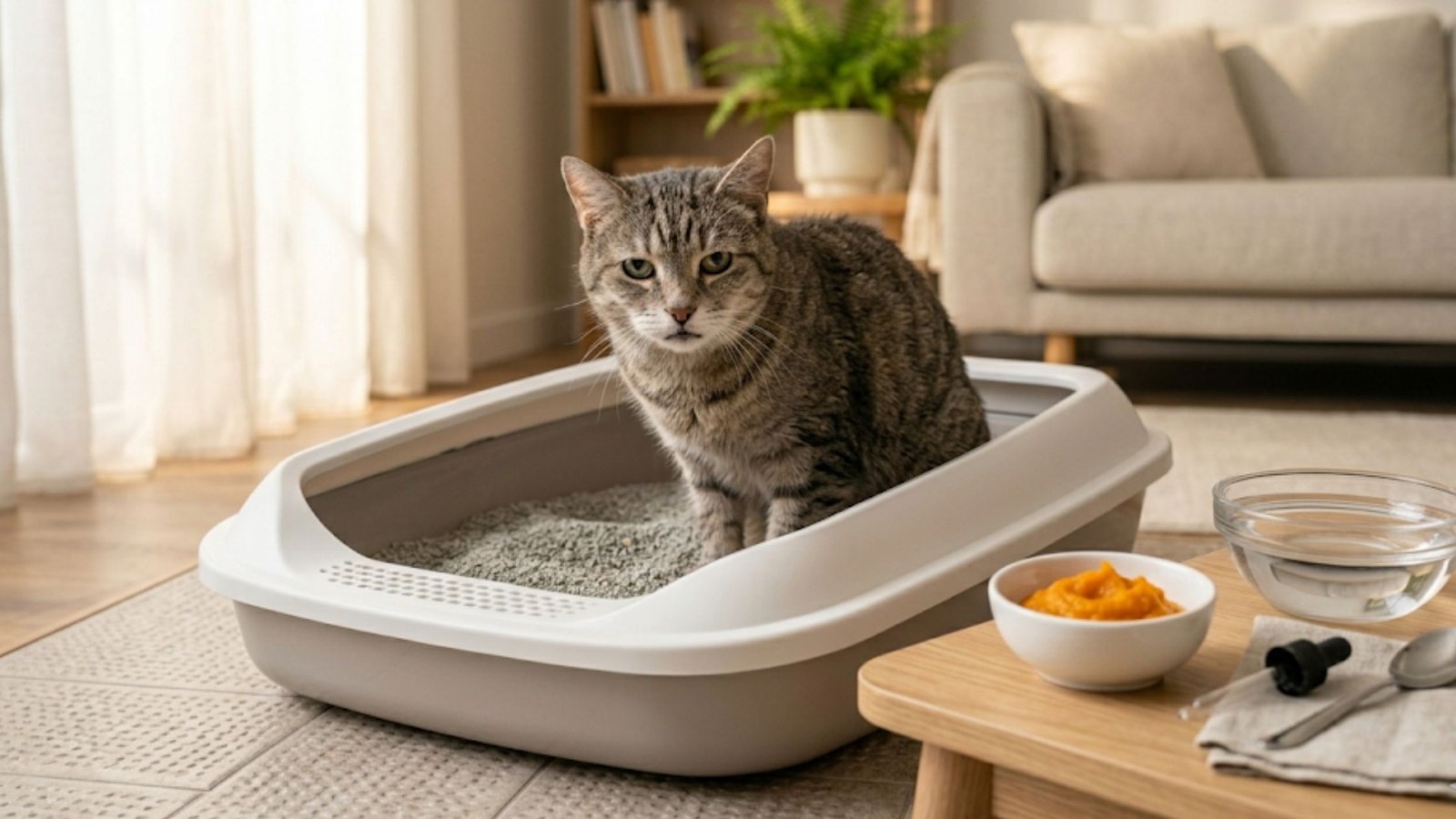
The first time I saw Luna straining in the litter box, I thought she was having trouble peeing.
She would go in, scratch around, squat… and nothing. Then she’d get out. Then go back in. Then squat again. Her little face looked confused. Frustrated. Almost scared.
I sat on the bathroom floor with her for an hour, watching, worrying, and trying not to panic.
Then she finally produced a single small, hard, dry poop. She looked at me like “that was exhausting” and walked away.
I knew something was wrong. Luna had always been regular—once a day, like clockwork. Now she was going every other day, and when she did go, it looked like rabbit pellets. Hard. Dry. Painful.
I called my vet. “It sounds like constipation,” they said. “Try some home remedies first. If she hasn’t pooped in 48 hours, bring her in.”
Those 48 hours were stressful. But the remedies worked. Luna is back to her regular self now—regular in every sense of the word.
If your cat is straining in the litter box, producing hard, dry stools, or going days without pooping, you’re probably feeling the same worry I did. Let me walk you through what I learned about cat constipation—the safe home remedies that actually help, and the red flags that mean you need to see a vet.
First, Is It Constipation or Something Else?
Before you try any home remedies, you need to be sure your cat is actually constipated.
Signs of constipation in cats:
| Symptom | What It Looks Like |
| Straining in the litter box | Cat goes in and out repeatedly, squats for long periods |
| Small, hard, dry stools | Poop looks like rabbit pellets or pebbles |
| No poop for 48+ hours | Normal is 1-2 times daily for most cats |
| Crying or vocalizing in the box | Pain when trying to pass stool |
| Licking rear end excessively | Discomfort or irritation |
| Decreased appetite | Feeling “backed up” and bloated |
| Lethargy | General discomfort |
What constipation is NOT:
| Symptom | Likely Cause |
| Blood in stool (red or dark) | Colitis, parasites, infection—see vet |
| Diarrhea with straining | Could be constipation with overflow (blockage) |
| Straining with no poop for 3+ days | Possible obstruction—emergency |
| Vomiting + no pooping | Possible intestinal blockage—emergency |
| Bloated, hard belly | Possible megacolon or blockage—emergency |
If your cat hasn’t pooped in 48-72 hours and is still eating and acting normal, home remedies are reasonable to try. If your cat hasn’t pooped in 72+ hours, or is vomiting, lethargic, or not eating, skip the home remedies and go to the vet.
Why Do Cats Get Constipated?
Understanding the cause helps you prevent it from happening again.
Cause 1: Dehydration (Most Common)
Cats have a naturally low thirst drive. They evolved to get most of their water from their prey (which is about 70-80% moisture). Dry kibble is only 5-10% moisture. A cat eating only dry food is chronically dehydrated.
What happens: The colon absorbs water from waste. If your cat is dehydrated, the colon pulls every drop of water it can, leaving the stool hard, dry, and difficult to pass.
Cause 2: Hairballs
Hairballs don’t just come up—they can also go down. Swallowed hair can accumulate in the intestines, mixing with stool and making it bulkier and harder to pass.
Cause 3: Low Fiber
Fiber adds bulk and moisture to stool, helping it move through the intestines. Cats on low-fiber diets (most commercial kibbles) may struggle with regularity.
Cause 4: Lack of Exercise
Sedentary cats have slower gut motility. Less movement = slower transit time = more water absorbed = harder stool.
Cause 5: Underlying Medical Conditions
- Kidney disease (common in seniors) → dehydration → constipation
- Hyperthyroidism → increased metabolism → dehydration
- Arthritis (painful to squat in litter box) → holding it in → stool gets harder
- Megacolon (colon loses ability to contract) → severe, chronic constipation
- Intestinal blockage (from string, foreign object) → emergency
Cause 6: Medications or Post-Surgery
Some medications (antihistamines, opioids, certain pain meds) slow gut motility. Anesthesia from surgery can also cause temporary constipation.
Safe Home Remedies for Cat Constipation
These are the remedies my vet recommended—and the ones that worked for Luna.
Remedy 1: Increase Water Intake (The Most Important)
You cannot fix constipation without addressing hydration. Nothing else will work if your cat is dehydrated.
How to do it:
| Method | How It Helps |
| Switch to wet food | Canned food is 78% moisture vs. 5-10% in kibble |
| Add water to wet food | Create a “soup” or “gravy” consistency |
| Pet water fountain | Many cats drink more from moving water |
| Multiple water bowls | Place in different rooms, away from litter box |
| Ice cubes | Some cats lick them out of curiosity |
| Flavored water | Add a teaspoon of tuna juice or low-sodium chicken broth |
Real story: Luna eats mostly dry food (she’s picky). When she was constipated, I started adding 2 tablespoons of warm water to her kibble, letting it soak for 5 minutes. She ate it without complaint. Within 24 hours, her stool was noticeably softer.
How fast it works: 24-48 hours for mild constipation.
Remedy 2: Canned Pumpkin (Not Pie Filling)
This is the classic home remedy for a reason. It works.
Why it works: Pumpkin is high in soluble fiber. Fiber absorbs water, softening stool while also adding bulk that helps the intestines push things along.
What to buy: 100% pure canned pumpkin. Not pumpkin pie filling (has sugar, spices, and additives that can upset your cat’s stomach).
How much to give:
- Adult cat: 1-2 teaspoons mixed into food, once or twice daily
- Kitten or small cat: 1/2 to 1 teaspoon
How to serve: Mix thoroughly into wet food. If your cat refuses, try warming it slightly (10 seconds in the microwave—stir well, no hot spots).
How fast it works: 12-24 hours for mild cases.
Real story: Luna refused pumpkin at first. I mixed 1 teaspoon into her favorite tuna-flavored wet food. She ate it. The next morning, she had a normal poop. I was so happy I almost cried.
Remedy 3: Plain Canned Tuna or Sardines (In Water)
The oil and moisture in fish can help lubricate the intestines and get things moving.
What to buy: Canned tuna or sardines packed in water (not oil, not brine, not salt-added). No spices, no flavors.
How much to give: 1-2 tablespoons of the fish, plus a little of the water from the can.
How to serve: Offer as a treat or mix into regular food.
Warning: Don’t rely on fish long-term. It’s high in mercury and not nutritionally balanced. Use only as a short-term remedy.
How fast it works: 12-24 hours.
Remedy 4: Olive Oil or Coconut Oil (A Little Goes a Long Way)
A small amount of oil can lubricate the intestines and soften stool.
How much to give:
- 1/4 to 1/2 teaspoon for an average adult cat
- Mix into food (don’t give straight—they may refuse or inhale it)
Which oil is best:
- Extra virgin olive oil (most commonly recommended)
- Coconut oil (solid at room temperature—melt before mixing)
Warning: Too much oil can cause diarrhea or pancreatitis. Start with a tiny amount (1/4 teaspoon) and see how your cat responds. Never give more than 1/2 teaspoon daily.
How fast it works: 24-48 hours.
Remedy 5: Psyllium Husk (Fiber Supplement)
This is the active ingredient in many human fiber supplements (like Metamucil). It’s a soluble fiber that absorbs water and bulks up stool.
What to buy: Unflavored, unsweetened psyllium husk powder. No added sugar, no artificial flavors (xylitol is deadly to cats).
How much to give: Start with 1/8 teaspoon mixed into wet food, once daily. Increase slowly to 1/4 teaspoon if needed.
Warning: Psyllium absorbs a LOT of water. You MUST ensure your cat is drinking enough water, or the psyllium can make constipation worse (or cause a blockage). Only use if your cat is well-hydrated.
How fast it works: 24-48 hours.
Remedy 6: Increase Exercise and Movement
Movement stimulates the digestive tract. A sedentary cat has slower gut motility.
How to do it:
- 10-15 minutes of play before meals (wand toys, laser pointer, fetch)
- Climbing opportunities (cat trees, shelves)
- Food puzzles (make them work for their kibble)
- Even just moving the food bowl to a different location encourages walking
Real story: Luna is lazy. When she was constipated, I started doing a 10-minute play session before each meal. She hated it at first (she wanted to nap). But the movement helped. Within two days, her system was moving better.
The 48-Hour Home Treatment Plan
Here’s exactly what I did for Luna. You can follow the same plan.
Day 1, Morning:
- Switch from dry to wet food (or add significant water to dry food)
- Add 1 teaspoon pumpkin to breakfast
- Add 1/4 teaspoon olive oil to breakfast
- 10-minute play session
Day 1, Afternoon:
- Offer fresh water (add ice cubes if your cat likes them)
- Another short play session
Day 1, Evening:
- Add 1 teaspoon pumpkin to dinner
- Add 1 tablespoon tuna water to dinner
- Another play session
Day 2, Morning:
- Check litter box
- If no poop yet, continue same routine
- If poop appears (even small), continue hydration and pumpkin
Day 2, Evening:
- If still no poop after 48 hours total, call your vet
What to expect: Many cats will poop within 12-24 hours of starting these remedies. Luna pooped the next morning. Some cats take 48 hours. If nothing has happened by 48 hours, your cat needs veterinary help.
What NOT to Do (Please Read This)
These “remedies” are dangerous. Do not try them.
Don’t Give Human Laxatives
No Miralax, no Dulcolax, no Metamucil (except psyllium husk, and only with vet approval). Human laxatives are formulated for human bodies and can cause severe dehydration, electrolyte imbalances, or toxicity in cats.
The exception: Some vets recommend Miralax (polyethylene glycol 3350) for cats at specific doses. But only under veterinary guidance. Do not dose it yourself.
Don’t Give Mineral Oil
Mineral oil used to be a common home remedy. It’s now known to be dangerous. Cats can inhale it into their lungs (aspiration pneumonia), and it interferes with nutrient absorption.
Don’t Give Enemas at Home
Human enemas (even small ones) can be deadly to cats. Many contain sodium phosphate, which causes severe electrolyte imbalances, seizures, and death in cats. Only a vet should administer an enema.
Don’t Use a Syringe to Force Water
If your cat won’t drink, forcing water with a syringe risks aspiration (water in the lungs). Offer water in appealing ways. Don’t force it.
Don’t Give Cow’s Milk
The old “milk for constipation” myth is dangerous. Most adult cats are lactose intolerant. Milk will cause gas, bloating, cramping, and diarrhea—not the gentle relief your cat needs.
Long-Term Prevention: Keeping Your Cat Regular
Once you’ve relieved the constipation, here’s how to prevent it from coming back.
1. Switch to Wet Food (or Add Water to Kibble)
This is the single most important change you can make. Cats are designed to get water from their food. Dry food is convenient, but it’s a major contributor to chronic dehydration and constipation.
If you can’t switch entirely to wet food: Add 2-4 tablespoons of warm water to each kibble meal. Let it soak for 5 minutes before serving.
2. Add a Daily Fiber Source
- 1 teaspoon of canned pumpkin (pure, not pie filling) daily
- 1/8 teaspoon of psyllium husk (with plenty of water)
- High-fiber cat food (prescription or over-the-counter)
3. Provide Fresh Water in Appealing Ways
- Pet water fountain (most cats drink more from moving water)
- Multiple bowls in different locations (away from litter box and food)
- Change water daily (cats are picky about stale water)
4. Regular Grooming (For Hairballs)
Brush your cat daily, especially during shedding season. Less swallowed hair = less bulk in the intestines.
Hairball remedies: Laxatone or Petromalt (hairball gel) 2-3 times weekly during shedding season.
5. Litter Box Management
- Clean boxes daily (some cats will hold it rather than use a dirty box)
- At least one box per cat, plus one extra
- Low-sided boxes for senior cats with arthritis
- Different litter types (some cats prefer certain textures)
6. Regular Exercise
Daily play sessions keep the whole digestive system moving. Aim for 15-20 minutes of active play each day.
When to See the Vet (Do Not Wait)
Home remedies are for mild, uncomplicated constipation. Some situations require veterinary care.
See a vet within 24 hours if:
| Symptom | Why |
| No poop for 48-72 hours despite home remedies | Constipation may be severe or caused by blockage |
| Cat is straining but producing only small amounts of liquid diarrhea | Overflow diarrhea (sign of severe impaction) |
| Cat is vomiting (especially if vomit smells like feces) | Intestinal blockage—emergency |
| Bloated, hard, painful belly | Possible megacolon or blockage |
| Cat is lethargic, hiding, or not eating | Systemic illness or severe discomfort |
| Blood in stool (red or dark, tarry) | Colitis, parasites, or internal bleeding |
See a vet immediately (emergency) if:
- The cat is straining with no production at all for 72+ hours.
- The cat is crying in pain.
- The cat has a known history of megacolon or previous blockages.
- The cat has ingested a foreign object (string, ribbon, toy).
Real story: A client’s cat hadn’t pooped in 4 days. The owner tried pumpkin, water, oil—everything. Nothing worked. When she finally took the cat to the vet, X-rays showed the colon was severely impacted. The cat needed enemas, IV fluids, and hospitalization for 2 days. The vet said: “If you had waited one more day, this would have been a surgical case.”
Don’t wait too long. Constipation that goes untreated can lead to megacolon—a condition where the colon becomes permanently stretched and loses the ability to contract. Megacolon is manageable but not curable.
What the Vet Will Do (If Home Remedies Fail)
If you end up at the vet, here’s what to expect.
Step 1: Physical Exam
The vet will feel your cat’s abdomen to assess how full the colon is.
Step 2: X-rays
To see how much stool is present, rule out blockages, and check for megacolon.
Step 3: Enema (Vet-Administered Only)
A warm water or medical enema to soften and flush out the stool. This is done under sedation or anesthesia (it’s uncomfortable).
Step 4: IV Fluids
To rehydrate your cat and soften the stool from the inside.
Step 5: Medication
Laxatives (lactulose) or gut motility drugs (cisapride) for ongoing management.
Cost: $200-500 for exam, X-rays, and enema. More if hospitalization is needed.
FAQ
How long can a cat go without pooping before it’s an emergency?
Most cats poop daily. 48 hours without poop is concerning. 72 hours without poop, especially with straining or other symptoms, is an emergency. If your cat hasn’t pooped in 72 hours and home remedies aren’t working, see a vet.
Can stress cause constipation in cats?
Yes. Stress slows down the digestive system. Common stressors: moving, new pet, new baby, construction, boarding, vet visits. If stress is the cause, address the stressor (Feliway diffusers, safe spaces, routine).
Is pumpkin or olive oil better for cat constipation?
Pumpkin is generally better for mild constipation because it adds fiber and moisture. Olive oil is better for cases where lubrication is needed (very dry, hard stool). You can use both together—just keep amounts small.
My cat is constipated but still eating. Is that okay?
Yes, eating is a good sign. It means the constipation is likely mild and not a complete blockage. Continue home remedies and monitor. If eating stops, see a vet.
Can dry food cause constipation?
Yes. Dry food is very low in moisture (5-10%). Cats on dry food are chronically dehydrated, which leads to hard, dry stool and constipation. Switching to wet food or adding water to kibble is the best prevention.
My senior cat is chronically constipated. What should I do?
Senior cats often have underlying issues (kidney disease, arthritis, megacolon) that contribute to constipation. Don’t rely on home remedies alone. See a vet for a senior workup (blood work, X-rays). Your cat may need prescription food, medication, or other long-term management.
Final Thoughts: Luna’s Litter Box Today
Luna hasn’t been constipated since that scary week. I made two changes that stuck:
- I add water to her kibble every single meal (about 2 tablespoons)
- She gets 1 teaspoon of pumpkin mixed into her dinner
That’s it. Two small changes. And she’s been regular ever since.
I still watch her in the litter box sometimes. Old habits. But now when I see her squat, I don’t hold my breath. I just wait for the sound of her scratching to cover it up.
It’s a small thing, a cat pooping. But when you’ve watched your little friend struggle, it becomes a big thing. A relief. A sign that everything is working the way it should.
If your cat is constipated right now, take a breath. Most cases are mild and respond well to simple home remedies. Hydrate, add pumpkin, be patient.
But also watch closely. Know the red flags. And don’t be afraid to call your vet.
Your cat can’t tell you what’s wrong. That’s why you’re reading this. That’s why you’re trying to help.
You’re a good cat parent. Your cat is lucky to have you.
Now go check that litter box. And maybe add some water to dinner.